
Tartarus: the Genius Loci, part 1
[This article is also available as a video.]
Nemesis is an Agatha Christie mystery written in 1971, in which Miss Marple is given a task by an attorney with no information about what the task actually is. We, as Christie’s readers, are in a similar situation with respect to the law. Certain things are expected of us as we attempt to navigate the hidden legal realm of jurisdiction, but we’re given no clear information about what those things are.
This line from the novel sums up the task of Miss Marple: “She had been directed, first to the lawyer's office, then to read a letter—two letters—in her home, then to be sent on a pleasant and well run tour round some of the Famous Houses and Gardens of Great Britain.” There’s no mention of a crime or even the concept of justice, but it does speak to homes and gardens, with an emphasis on place.
The plot slowly unfolds showing that Miss Marple will be attempting to solve the murder of a girl named Verity Hunt, making Miss Marple’s task a “truth hunt.”
In the story, it’s been arranged for Miss Marple to take a tour of “Famous Houses and Gardens of Great Britain,” known as Tour 37. Other women also on this tour are named Miss Lumley, Mrs. Riseley-Porter, Miss Barrow, and Elizabeth Temple, all names that relate to sacred points in the land: two ending in -ley, suggesting the ley lines that lead to barrows and temples throughout the English countryside.
In Chapter 5, we’re told that, “Mrs. Riseley-Porter, however, might have information of some kind which Miss Marple might find had a bearing on matters.” Mrs. Riseley-Porter turns out to have no impact on the story at all, but the mention of her name with regard to the concept of “bearing” is giving us a hint about place, the power or spirit of place known as the genius loci.
The more ancient meaning of “ley” or “lea” is a meadow or field, though Stapledon and Davies clarify that definition in their book, Ley Farming: “Ley, lea or lay, the Oxford Dictionary tells us inter alia implies arable land under grass; land laid down for pasture; grassland.” So a “ley line” would seem to mean lines running through the meadows and fields.
Because ancient ley lines were also paths from one site to another, it’s easy to presume that the word “lane” may have evolved from the two words, “ley line.” And it’s on a “lane” that the girl named Verity, or Truth, was found dead, as it was explained to Miss Marple by a character named Clotilde: "Then they found her… In a kind of ditch hedgy spot down an unfrequented lane where anyone hardly ever went. Yes, I had to go and view the body in the mortuary. A terrible sight… I can't bear it, I can't bear it."
The repetition of “bear it” points back to the word “bearing,” calling to mind the importance of place: “…there was something here that she ought to notice… something she ought to take note of, something that had a bearing.”
We use bearings to navigate the earth’s grid, to find the direction or heading we need to reach a specific location. A specific location is a specific point on the earth’s grid, measured using latitude and longitude in the macro, or metes and bounds in the micro. Wikipediatells us that a bearing is an azimuth, the clockwise angle between a precise location on the earth’s grid and true north.
On his website, “Ley Lines Decoded,” Mike Peer tells of something he found on the earth grid:
Some forty years ago I made an extraordinary discovery—certain ancient sites in the area around my home town of Guildford were arranged within the landscape in a seemingly intentional pattern. Some sites fall upon bearings of ten degrees from a common point and are aligned at regular distances from that point… On one alignment I calculated a high point where I suspected a site may have existed and consequently discovered an unrecorded barrow at precisely that point—later confirmed by the County Archaeologist."
A barrow is an ancient burial mound, a specific location on the earth’s grid where the dead have been consecrated. And it was the failure to find Verity’s body, to successfully navigate to the unfrequented lane, that allowed her killer to hide the murder for so long. But, spoiler alert (if you plan to read or watch Nemesis)… the character of Miss Barrow is pointing us to the fact that the body of Verity was not the body found on the lane; Verity’s body would be found later, consecrated in a barrow mound in the Bradbury-Scott’s garden. Agatha Christie has Miss Marple navigating a series of bearings and ley lines to sort out the death of Verity Hunt.
However, a subplot then emerges in Nemesis: a new murder takes place, the murder of Elizabeth Temple, as she ascends a hill or high place housing a “memorial tower.” Here, the metaphor links death with a temple. And unlike the first body, found dead in a low ditch, Miss Temple is killed on a high point of land.
Miss Marple isn’t present when this crime occurs because her benefactor, Jason Rafiel, has set her up for a few days in the Old Manor House. He’s done this because “he thought [Miss Marple] was not fit to attempt the particular ascent of this rather difficult climb up the headland to where there was a memorial tower…” This hinting at the difficulty and danger of elevated land rings back to the name of Mrs. Riseley-Porter whose name suggests a ley line that’s rising.
We’ve come to describe the rising and falling of land as the “lay of the land,” but perhaps it’s more accurately termed the ley of the land.
In this case, the members of Tour 37 are following a ley line or path that’s rising to the location of a memorial tower, a place for remembering the dead.
Re-membering the dead.
Of course, a memorial tower is really more about honoring the dead, whereas the verb “remember” can be literally defined as what Isis did when Osiris was dismembered by Seth. It was more than simply honoring him. She re-membered him.
Another way of saying this is that she reincorporated him into a corpus, a single body rather than one partitioned out into its various members.
Genius loci
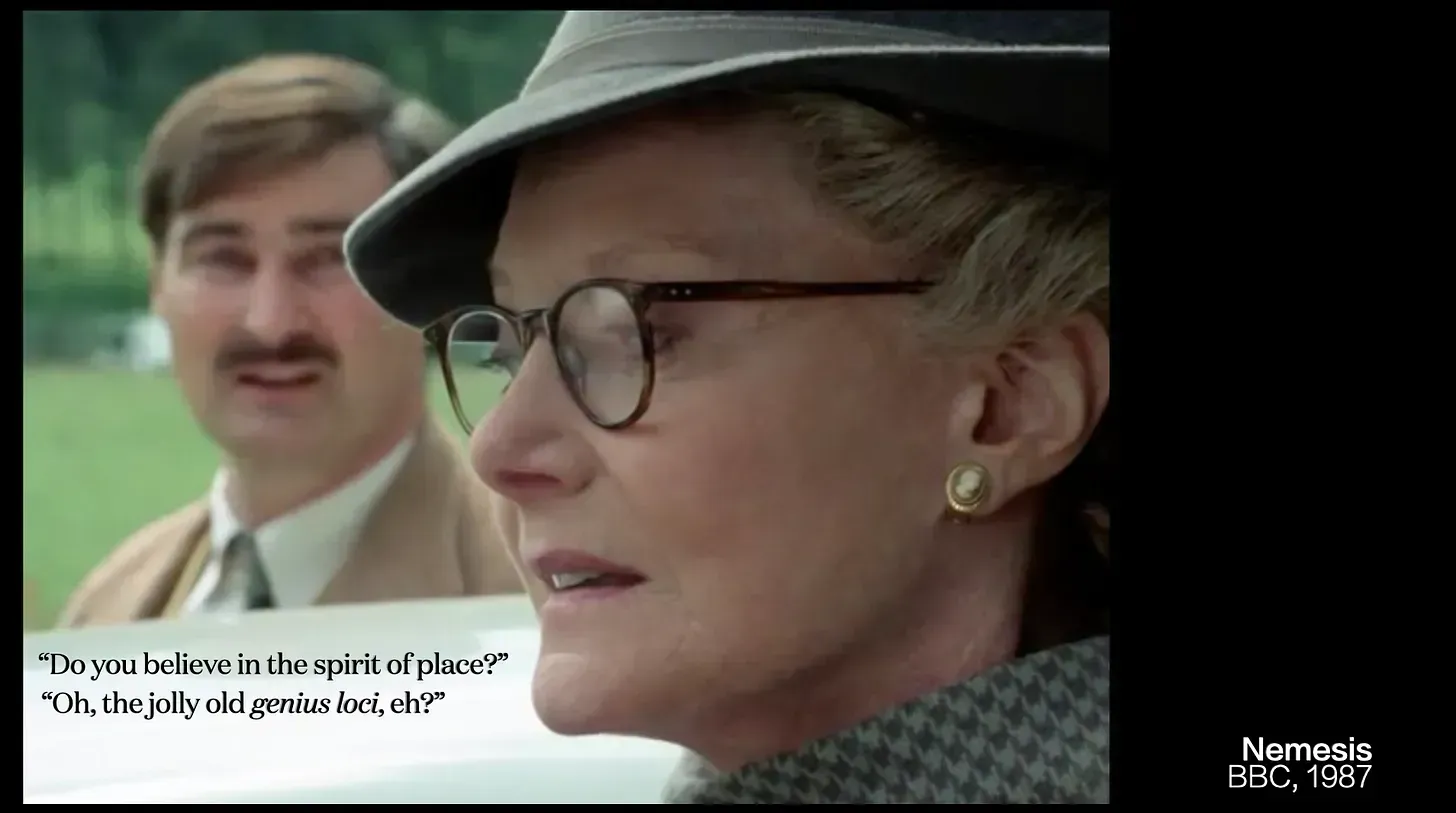
There’s a televised scene from Nemesis on the BBC that wasn’t in Agatha Christie’s novel, where Elizabeth Temple asks Miss Marple’s nephew if he believes in the spirit of place. He responds by saying, “Oh, the jolly old genius loci, eh?” This is an interesting addition to the story. It connects Christie’s Nemesis to Alexander Pope’s Moral Essays as Miss Marple’s Tour 37 of houses and gardens is essentially the same framework used by Alexander Pope to discuss the genius loci.
Genius loci was first expressed in the pre-Christian Roman classical religion. We’re told it embodied a “protective” spirit of place. This understanding may have evolved from the description, in Plato’s Republic, of the role of a “genius.” In Book 10’s Myth of Ur, Plato wrote of a spirit that directs our lives: "And Lachesis sent with each, as the guardian of his life and the fulfiller of his choice, the genius that he had chosen and this divinity led the soul first to Clotho, under her hand and her turning of the spindle to ratify the destiny of his lot and choice; and after contact with her the genius again led the soul to the spinning of Atropos to make the web of its destiny irreversible…"
This genius later came to be understood as a person’s innate abilities, but was also associated with the innate abilities of a place.
Thousands of years later, in 1751, Alexander Pope would refer to this importance of “…architecture and gardening [homes and gardens], where all must be adapted to the genius and use of the place…” In Epistle 4, Pope writes that we should: "Consult the genius of the place in all that tells the waters or to rife or fall, Or helps th’ ambitious hill the heav’ns to fcale, or scoops in circling theatres the vale…"
Eventually Pope acknowledges that the genius loci “directs” the “intending lines.” Was he referring to the lines of ley that rise and fall with each hill and valley?
Another character on Tour 37 is Emlyn Price, a young man distracting the attention of Mrs. Riseley-Porter’s neice, attention that Mrs. Riseley-Porter wished to remain on her. As such, Emlyn and Mrs. Riseley-Porter are at odds. The name Emlyn means “around the valley,” and Christie is actually naming characters with terms that describe land to pit those characters against one another.
But noticing the differences and purposes between low lands and high lands is part of acknowledging Pope’s concept of the genius loci. In A Pattern Language, a 20th century book on city planning that Dane Quirk shared with me, Christopher Alexander points out that low lands, where water pools, are generally most useful for growing water-hungry crops, while higher land is better suited for erecting flood-averse structures like homes and churches. As Pope suggests, this is a recognition of which places are best suited for which activities, or of consulting the genius of place in all.
Another purpose of elevated land is to locate line-of-sight towers and monuments. Cort Lindahl makes a connection between the temple, the monument, and the ley line in his book, The Sacred Towers of the Axis Mundi, writing that, “A wide variety of temples or monuments may have been left that included geometrical and philosophical data for later generations to ponder. In this way they may have been assuring that this information would not be lost in a natural cataclysm or destructive conflict…”
Lindahl continues, “There is unmistakable evidence that some of these Axes Mundi were built to point to other monuments that were built by the same people or those who identified with them and occasionally by opposing groups. Later adherents or members of the same order also valued these ‘ley lines’ and also placed buildings, events, and even entire cities in this context… many structures may have been built to both warn us while also recording valuable information for any catastrophe survivors. These monuments were meant to stand the test of time and the elements.”
According to Mark Alan Wright, “An axis mundi is a sacred place that connects heaven and earth…” One example is Jacob’s Ladder, an axisthat provides access to a different place: a portal. When Elizabeth Temple is killed ascending to the Memorial Tower, she represents the metaphorical “body,” as the body is considered a “temple.” The death of the body/temple suggests she successfully passed through the portal into either heaven or the underworld.
Elizabeth Temple, the body as temple, comprises one individual. But a body is then composed of parts like muscles, organs, and bones, that are held together by fascia, bands of membranous, connective tissue. The word “fascia” has evolved from the “fasces” of ancient Greece, referring to the bands that bind this bundle of sticks together. The fasces represents fascism, and it symbolized the group bound together as one—incorporation—but when an ax-head was present, it also symbolized the group as responsible for the violence of that ax, the entire city-state bound together and wielding the weapon, not just the magistrate or warrior who swung it. This is why fascism is also described today as “corporatism”—the bound bundle reflects the corporate form and structure.
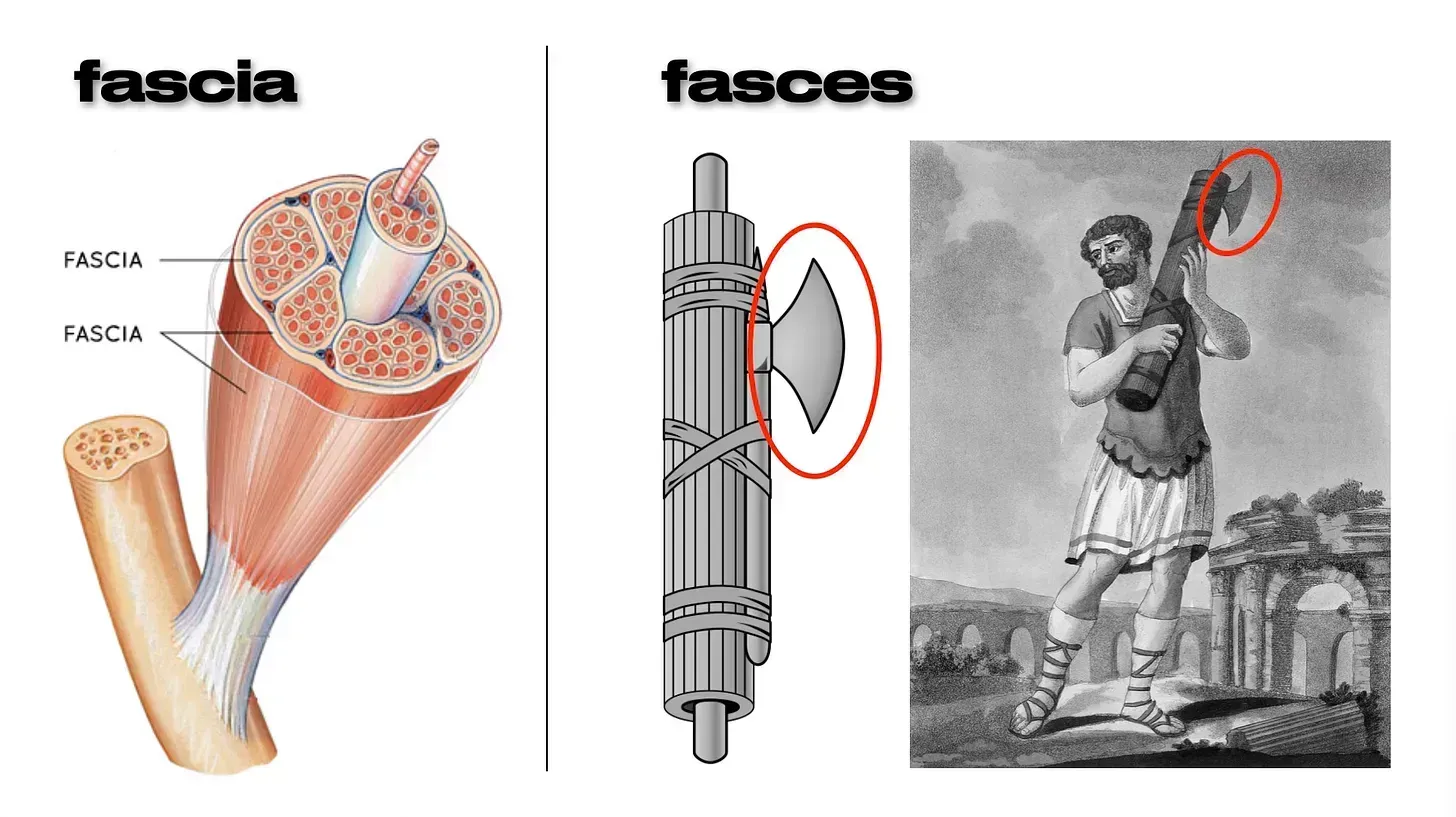
From the word fasces we also get the word “fasten,” meaning to close or bind up with buttons, snaps, or a clasp… as well as the word “fascinate,” which means to bewitch or captivate, and “captivate” alludes back to “capture.”
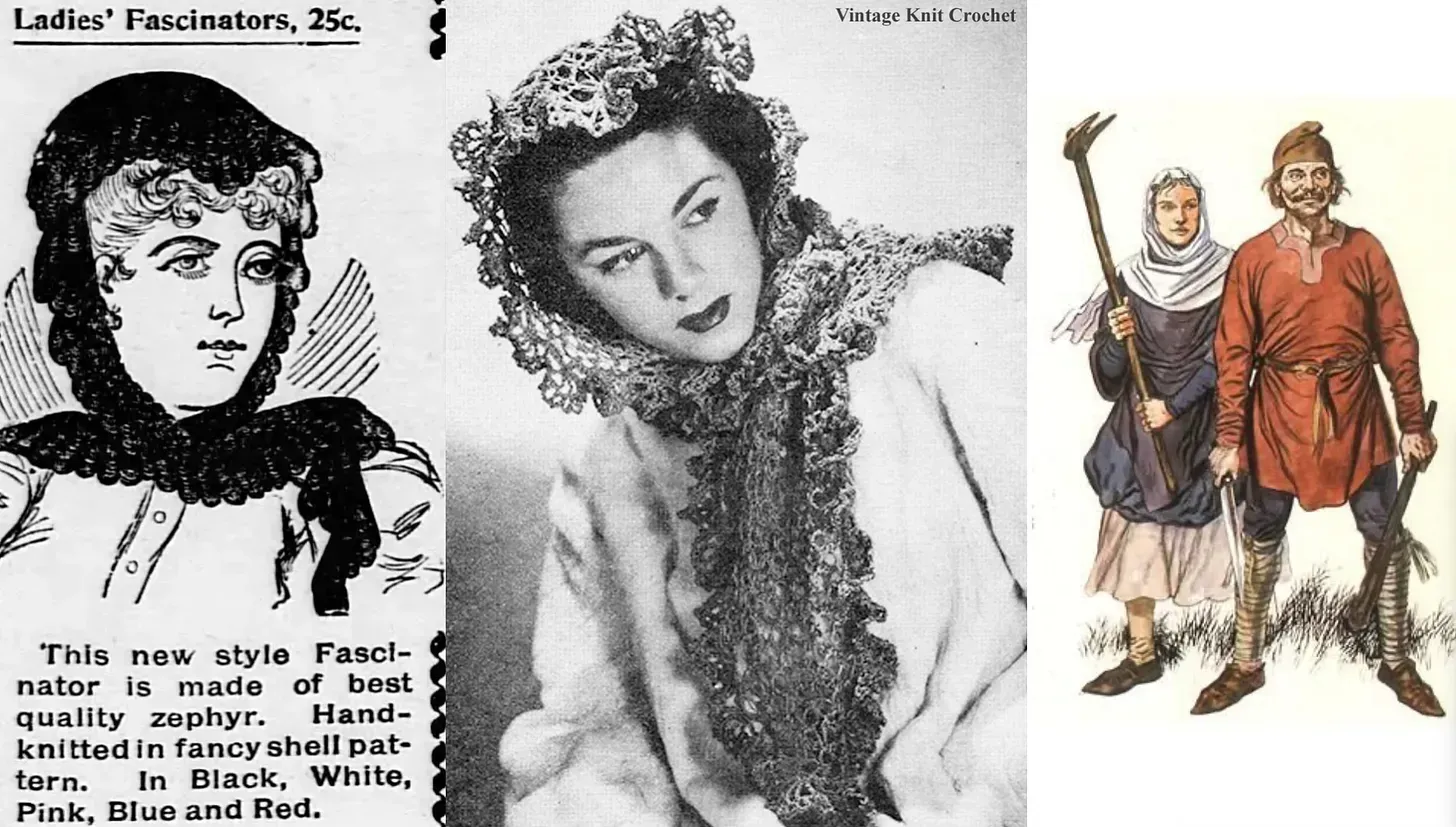
A term closely related to “fascinate” is used by Agatha Christie in Nemesis: “…she remembered wearing that pink shawl-scarf she'd been wearing—what used they to call them when she was young?—a fascinator. That nice pink shawl-scarf of wool that she had put round her head, he had looked at her and laughed, and later when she had said—she smiled at the remembrance—one word she had used and he had laughed…” The one word is nemesis, and she was the goddess of retribution who metes out justice. It presents an ironic image: a little old lady wearing a silly head scarf posing as the vengeful goddess of justice. But there’s another reason that it’s ironic: the fascinator is peasant-wear, described as “hood shaped,” and this fascinator, fastened or closed headwear, is reminiscent of the peasant’s captive position, the serf’s bond to the farmland of the manor. It alludes to the manor house, the lands surrounding it, and the history of the people who were bound to it.
This idea, that the body is a temple and the body is bound to the land, is clarified in 1 Corinthians 6:19 of the 1611 King James Bible. This chapter is prefaced with the comment: “Our bodies are the members of Christ.” It goes on to explain that our bodies belong to God and have been bought with a price. The individual has no rights. Like a slave or a serf, the individual has been “bought” and does not own him- or herself. You are a place in physical reality and it’s a place you don’t “legally” own.
Such places—even today—are often owned by a corporation.
Law of the land
There’s an unimportant character in Agatha Christie’s Nemesisnamed Edmund Anderson. He never appears in the story; he’s only briefly mentioned as the second husband of Jason Rafiel’s former secretary and a train engineer who “runs the Time and Motion branch.” But his first name, Edmund, contains the root of the Latin mundi, meaning world, and we might correlate the railway lines that Edmund Anderson was managing the axes mundi or ley lines running across the English countryside.
But the Edmund Anderson rabbit hole goes much, much deeper than that.
It turns out there was also a real man named Edmund Anderson. He was a legal colleague of Francis Bacon, praised and well-liked by Bacon. In 1581, Edmund Anderson was counsel for Plaintiff in a famous land dispute known as Shelley’s Case. Counsel for the Defense was Edward Coke, the legal rival of Francis Bacon who often comes up in my research. Shelley’s Case is central not only to our understanding of place as genius loci, but also to our understanding of the inheritance of place, the inheritance of land.
This is the text from the May, 1540 land grant of Barhamwyke in Sussex from King Henry VIII to Anne Cobham and then to Edward Shelley, land that had been owned by the newly dissolved monastery of Syon.
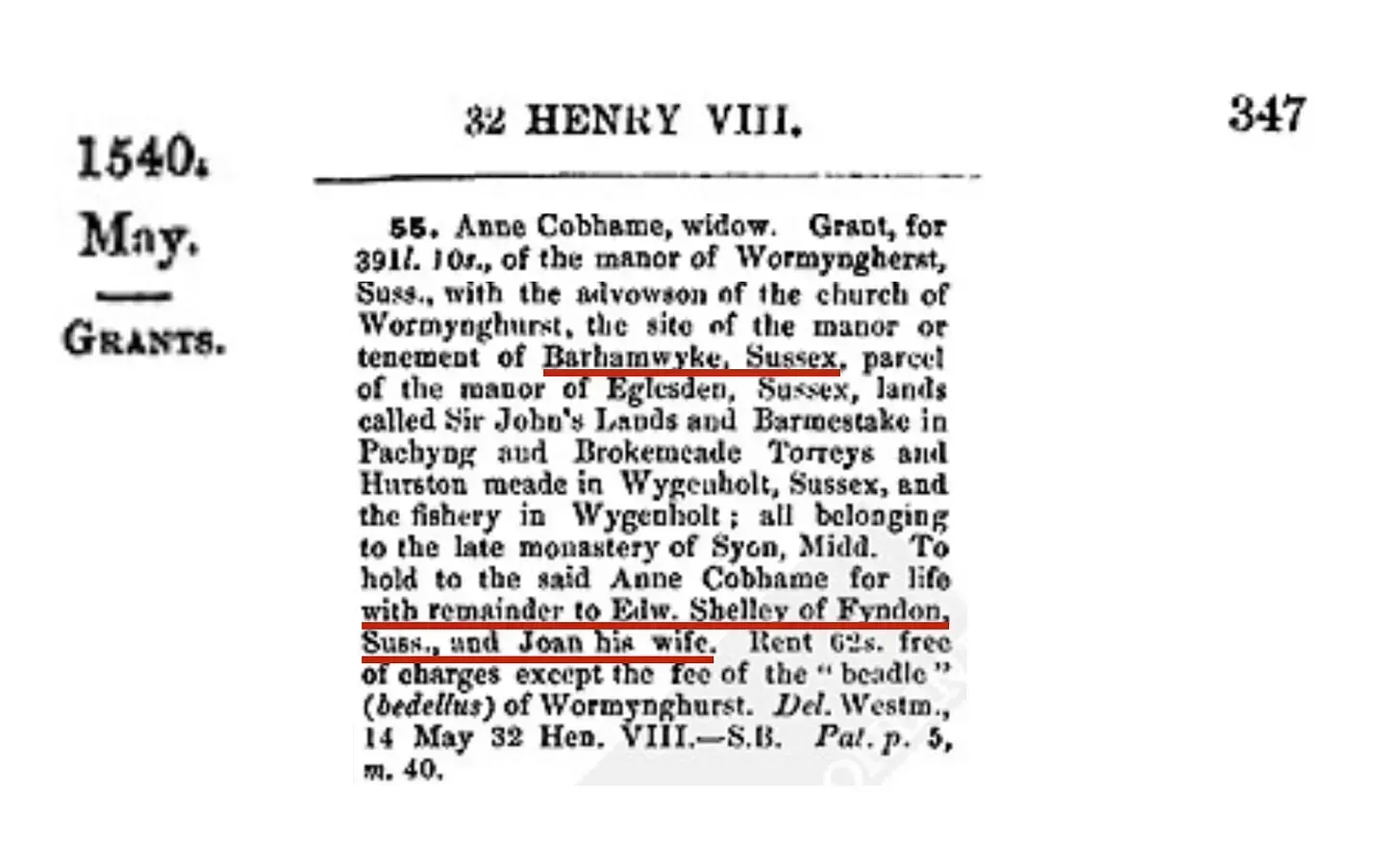
The facts of Shelley’s Case have been documented in modern language by Brian Simpson in his 1995 book, Leading Cases in the Common Law: "The farm had been granted by Henry VIII to … Anne Cobham for her life, and then, by way of remainder, to Edward Shelley and his wife, and the heirs of their bodies begotten. This entailed the lands. Unless the entail was broken, they would pass after the death of Edward and Johan to the direct descendants of their marriage—to their lineal heirs. The final provision of the letters patent of 1540 was a remainder in fee simple to ‘the right heirs of Edward Shelley’."
The term, fee simple, according to Oxford Languages, means “a permanent and absolute tenure in land with freedom to dispose of it at will.” Notice that this fee simple remainder was not granted to Edward, but to his heirs.
David Smith continues the story in The Journal of Legal History: "By 1554 the Shelleys had prospered and Edward had two sons who survived into adulthood. Henry was the elder and having married, had a daughter named Mary. Richard, the younger son, was still unmarried. That same year, however, the fortunes of the Shelleys changed for the worse when an unknown sickness first took Joan and then Henry. Edward Shelley himself was soon afflicted, and aware that upon his death the entail would guide the descent of the land to Mary, he sought to retain the land within the male line of the family… Edward chose to resettle his lands by an indenture. The indenture instructed recoverors to break the entail by suffering a common recovery to the use of Edward Shelley for his life, and then to lessees for twenty-four years…"
This indenture blocked the inheritance of Mary Shelley, ensuring that only a male heir would inherit the land, as Coke explained in his report of the case: "The reason wherefore the said Edward Shelley suffered the said recovery was, (as it seemeth) because Mary, daughter of his eldest son named in the special verdict, had inherited; and if the wife of his eldest son had been delivered of a daughter, then had the land gone out of his name, and therefore for the continuance of the land in his name and family, he suffered the said recovery."
Twenty-five years after Edward Shelley died, a lawsuit was filed by Nicholas Wolfe, who was now renting the land from Edward’s second son, Richard Shelley. Wolfe accused one Henry Shelley Jr. of trespassing on the land. Henry Jr. was the younger brother of Mary, whose entail had been broken by their grandfather, Edward. So although the caption of the case reads Wolfe v. Shelley, the suit really reflects the land dispute between the uncle, Richard Shelley, whose case was argued by Edmund Anderson et al., and his nephew, Henry Shelley Jr., represented by Edward Coke.
If Richard Shelley had won the case (he didn’t), it would have been a win for Edward Shelley’s “heirs” (a designation that included Richard). But if Henry Jr., the son of Edward’s eldest child, won the case, it would be a win for one heir, the first born, a custom known as primogeniture. And a win for primogeniture was also a win for Parliament, which is why Coke argued so strongly for it.
Why would it be a win for Parliament? Because primogeniture has historically been pushed by Parliament.
In 1797, Edward Hasted explained this by first discussing the opposite of primogeniture, a common inheritance custom in Kent called gavelkind. He began the discussion by referring to the “socage tenures of antient demefne and gavelkind,” meaning the feudal tenure of ancient domains of land and the partitioning of that land among several heirs.
Hasted goes on to state that, “It is laid down as a rule, that nothing but an act of parliament can change the nature of gavelkind lands, and this has occasioned the passing of several, for the purpose of disgavelling the possessions of divers gentlemen in this county…” To disgavel meant to force primogeniture (limiting inheritance to one heir), thereby preventing landowners from bequeathing their lands to more than one heir.
According to Courtney Stanhope Kenny, in his essay on the history of English primogeniture, Parliament pushed primogeniture because paritioning land was seen as a threat to military strength.
Bracton lays down a further rule…” Kenny writes, “which vividly illustrates the military advantage of primogeniture. Where a partition takes place, the manor house or castle which is the chief building of a county or a barony, must not be parted. It must be given into the sole charge of the eldest son or daughter, ‘for the right of the sword, which suffers no division.
Kenny also states on another page that it was for the sake of the military system alone that primogeniture had been introduced.
Primogeniture also ensured that younger born sons, having no ownership or stake in their family’s estate, could be conscripted more easily into the military.
But wait, why was primogeniture only pushed by the British Parliament? Surely the monarch would have also recognized that primogeniture was necessary for military strength. Kings even use primogeniture to guide descent to the throne! But kings and queens are also human beings and easily swayed by the human desire to provide for all of their own children. Many kings were guilty of partioning up their own empires among squabbling and warring children. Even Henry VIII, himself, who treated women rather poorly, was known to have divided his holdings up, giving estates of land to wives he’d divorced, like Anne of Cleves. These decisions weren’t made according to policy; they were based on Henry’s own feelings of favor or guilt. The point is that kings are human beings with such feelings and Parliaments are not; it’s much easier to centralize control at the expense of beloved children when the entity making those decisions is unaccountable, un-blame-able.
And that was the strength of a corporate Parliament: it was faceless. Just as the members of a firing squad don’t know which one fired the lethal shot, members of groups like Parliament aren’t accountable as individuals and difficult decisions are made more easily. This is the point, the very definition of a corporation: it removes liability from its human members.
Shelley’s Case had a real bearing on how Parliament could use the law to further push primogeniture and further diminish gavelkind, multiple heirs, and ultimately, the decentralization of family land holdings over time. One of its effects was Coke’s use—his actual invention—of two confusing legal terms: “words of purchase” and “words of limitation.” They refer to two aspects of a land transfer: “words of limitation” describe the land being conveyed and “words of purchase” describe the people taking possession of the land.
Our modern definition of purchase is not what’s meant here by Coke. Wikipedia explains that, “The word purchase in the expression means that real property is being transferred by deed or will, not inherited through the laws of descent and distribution.” If there was no will, the rules of primogeniture kicked in, but wills, grants, and indentures were often constructed when someone wished to circumvent primogeniture. This is exactly what Edward Shelley was doing with his indenture: circumventing the primogeniture descent of his estate to Mary.
But according to Smith, Coke argued in Shelley’s Case that, “The failure of the [will’s] indenture to name Richard directly… suggested that Edward's intended settlement favoured Henry.” In other words, Coke presumed that Edward Shelley’s will was now reverting back to primogeniture, even though the plural word “heirs” meant just the opposite. In doing this, Coke was blatantly thwarting Edward Shelley’s own intent.
Smith tells us this in a footnote: "As Anderson himself stated the argument: ‘by these words the intent of Edward appears that he did not wish to have these words, heirs male of the body of Edward, to be words of inheritance, but words of purchase, and the reason [is] because he limited which manner of estate they would have, so that, by this manner of exposition all the words are able to stand and none of them are void'."
This may seem like tiresome semantics, but the verdict’s result, known as the Shelley’s Case “Rule,” became law, stipulating that, “if a single grant gives a freehold estate to a person and a remainder to the person's heirs, the remainder belongs to the named person and not the heirs.” This was a sweeping power grab by the court and by Parliament to undermine the intent of either a grant or a will.
One defense of the Rule, published in Fordham Law Review, addresses this very problem, that it can undermine intent: “The chief ground of adverse criticism has been the assumption that the Rule is an inflexible doctrine which flies in the face of the settlor’s intention.” This quote then admits what was just perjoratively labeled an “assumption” is absolutely true: “As long as the rule of primogeniture and the preservation of great landed estates remained the keystones of the English law of inheritance, the Rule in Shelley’s Case effected a just result for, while it concededly thwarted the particular intent, it did so only that the paramount intent might be effectuated.”
In Coke’s report of the case, he writes: “And Anderson sergeant said, it was impossible that Richard Shelley should be in by descent, because no right, title, action, use… [etc.] limited by the said indentures did descend to Richard, but only a thing intended to him, which intent in his life received no perfection…” In law, the word “perfection” means “completion,” so again, this case was about Edward’s intent that not only received no legal perfection, but was later actually thwarted by the law.
Francis Bacon also criticized the Rule’s ability to reverse a grantor’s intent. In his “Reading on the Statute of Uses,” Bacon refers to the Rule: “[T]he conceit [legal presumption] of Shelley in 24 H. VIII. … seemeth to me to be without ground, which was, that the use succeeded the tenure.” A “use” was like a trust, created in medieval times as a legal work-around for the strict feudal laws of the conveyance of land (tenure). When Bacon says that “the use succeeded the tenure,” he’s saying that the “use” had become as strict and feudal as the land tenure rules it was supposed to replace. And the “use” (a separation of title-holder and beneficiary, like a trust) was presumed regardless of intent, just as Coke was literally presuming that King Henry VIII had granted Barhamwyke as fee simple (to Edward only) rather than fee tail (to Edward, and then his heirs). Again, flying in the face of the king’s intent.
The king very clearly granted the land to Anne Cobham, then Edward Shelley, with a “remainder” for his heirs. Coke’s assumption that “heirs” was a word of limitation rather than a word of purchase is an example of feudal logic, reverting back to the rules of tenure, rather than the intent of the king’s grant of land.
And Coke reverted to feudal logic for one reason: to prevent multiple heirs fragmenting the estate, just as feudal laws did in their time. This was a way to ramrod primogeniture even when the will didn’t choose primogeniture. ChatGPT comes to a similar conclusion, showing that the goal of Parliament was the same goal of feudalism: to prevent the fragmentation of land to accommodate multiple heirs.
History has judged Coke’s legal construction or presumption harshly, and the Rule it established has been abolished in nearly every jurisdiction of common law. But it did adversely affect the heirs of Edward Shelley and 200 years later, another woman named Mary Shelley—Mary Wollstonecraft Shelley—would write Frankenstein, an allegory about the legal “monster” and its inability to inherit land. This Mary Shelley happened to be the wife of Percy Bysshe Shelley, Edward’s 8th great-grandson.
When I deep-dived the story of Frankenstein, I found that the concept of re-membering separated body parts into a living monster was equated with the legal act of declaring the dead to be alive or C’estui Que Vie, literally “he who lives.”
As mentioned earlier, Edmund Anderson ended up losing Shelley’s Case. But why would Agatha Christie place into Nemesis the name of Edmund Anderson, a 16th century barrister who lost a land inheritance case to Edward Coke?
It may seem like a coincidence, but Christie does make several subtle points in the novel on the topic of inheritance. The woman who would later marry Edmund Anderson had received an inheritance from Mr. Rafiel. In fact, the only people in Nemesis who inherit anything are females.
The three Bradbury-Scott sisters have inherited the Old Manor House from their uncle, a detail that points back to the Shelley Case, with the nephew and his uncle fighting over the inheritance of Barhamwyke Manor. This detail was changed in the BBC version to a different backstory in which the Bradbury-Scott girls had grown up there. But in the novel, Miss Marple remarks that, “The [girls] didn't belong to this house. It had belonged to an uncle of theirs and they'd come here to live some years ago.”
Agatha Christie also seems to be saying something about Edmund Anderson, himself. The narration describing Esther Walters, the woman who would later marry Edmund Anderson, paints the relationship with suspicion: “Miss Marple hoped that Esther Walters had married again, some nice, kindly, reliable man. It seemed faintly unlikely. Esther Walters, she thought, had had rather a genius for liking the wrong kind of men to marry.”
Was Edmund Anderson the wrong kind of man?
Maybe so. In contrast to Anderson, the character in Nemesis with Coke’s name is eventually revealed as a protector. Edmund Anderson is mentioned in the novel only once and quickly forgotten.
It should not be lost on Christie’s mystery readers that the murderer here is Clotilde, the woman who inherited the Old Manor House. If we dig a bit deeper, we uncover the reason why Clotilde inherited the Old Manor House from her uncle: “[Her uncle] only had one son, you see,” explained Miss Bradbury-Scott, “and he was killed in the war.” It’s restated, for emphasis, in Chapter 10: “Belonged to old Colonel Bradbury-Scott, The Old Manor House did…” — “Did he have any children?” — “A son what was killed in the war. That's why he left the place to his nieces. Nobody else to leave it to.”
Young men killed in war becomes a bit of a theme in Nemesis, and we see it again in Chapter 8 when Anthea is talking of the manor’s garden. “[D]uring the war one could not get any gardeners. We had a very young gardener and then he was called up. One does not of course grudge that…” Anthea is articulating here the disposable nature of the young with respect to war.
And it’s really war that killed truth, by allowing inheritances that never should have happened, giving access to the manor desmeans that, through murder, turned home and garden into a grave-barrow and memorial.
But a more obvious take-away from Nemesis is the fact that truth is to be found in barrows, that the genius loci of the barrow, mound, or hill should be noticed for its “bearing” on matters, and I think Christie does a decent job of highlighting the importance of place, the genius loci, through fiction.
Birth of a legal fiction
In 1588, Edward Coke shows up on our radar again, this time arguing for Plaintiff in the case of Marriot v. Pascall. This case, though, isn’t about land inheritance; it’s about the importance of place, the genius loci, in a legal corporation.
Coke’s plaintiff was attempting to evict Pascall from the Hospital of the Savoy because Pascall’s lease used a name for the hospital that failed to designate, in “certainty,” the corporation’s physical location. Coke writes: "To prove my Minor, I do say that this word (de) as here, de Savoy, designes a place, so as by this Word (de) the place is become parcel of the Name… but only the very name… for here by pretence of the Name in this Lease, there is not any place of the Corporation in the Name, but the Corporation is transitory, which cannot be, for a Corporation especial consisting of many persons, as Corpus aggregatum ought to have a certain place of their abiding, or otherwise it cannot be discerned by the Law, and it is but a Mathematical thing, and nothing else but a fiction, and they cannot be otherwise considered in Law, but as they are circumscripti within the bounds of their house…"
And this admission by Coke, that a corporation is “nothing else but a fiction,” is the result of the fact that the corporation has a name only, and no place. Its location is what makes it real and is what pulls it into the legal realm of a “real entity.”
A similar legal case, relating to place, came up 24 years later called the case of Sutton’s Hospital, still cited today as a landmark legal precedent that shaped all of corporate law. In 1612, Coke was now Chief Justice of the Common Pleas and Bacon had risen to solicitor general; more importantly, the rivalry between them was now quite heated.
Like Coke had done 24 years earlier in Marriot vs. Pascall, Bacon now argued for the necessity of corporate place, something the Sutton Hospital corporation lacked, and his argument was this: "The place of every Corporation ought to be certain, for without a certain place there cannot be any Incorporation… a place by a known name is not sufficient to support the name of an Incorporation, but the same ought to be described by metes and bounds…"
In these arguments of both Coke in 1588 and Bacon in 1612, a real, physical place was seen as a legally necessary feature of a corporation, as the name, alone, was insufficient. In fact, as Coke pointed out in Marriot vs. Pascall, the name of the Hospital of the Savoy was a pretense, and without a corresponding place—referred to in the name the corporation—it was nothing “but a fiction.” Back then, the genius loci or the spirit of “place” is what separated a real corporation from a legal fiction.
Keep in mind that Coke and Bacon were rivals who usually sat on the opposite sides of an issue. Now, in 1612 Coke sat as judge in the case of Sutton’s Hospital and, here, he ruled against Bacon’s “real entity” argument. Coke wrote: "[A]s to the 4th exception, that the place of every corporation ought to be certain… to that the charter itself expressly answers, that the King by this clause doth ordain, &c. ‘That the said house and other the premises shall from henceforth for ever hereafter be, remain, &c. and shall for ever hereafter be named and called the Hospital of King James founded in the Charterhouse:’… yet all the house itself, gardens and orchards, &c. are named by the name of the Hospital."
Now, suddenly, a name was enough.
But the problem was that the hospital hadn’t been built before Mr. Sutton died, so the house was quite a different physical reality than the intended incorporated hospital. Coke had an answer for that, as well: "For the said ordinance, that the said house should be an hospital… is intended only of the mechanical part of an actual hospital… And this hospital in intention only is sufficient to support the name of a corporation, and the words de praesenti… do in law incorporate them presently, and shall not stay till there be an actual hospital, or till the house be fitted or furnished, which is the mechanical part of the hospital."
The legal necessity of a real entity, an “actual” hospital, was now dismissed by Coke as something unnecessary, simply “mechanical,” something Coke, himself, described as both “mathematical” and “fictional” 24 years earlier.
And yet, even Coke, in his back-pedaling on the importance of place, admitted that there had to be something else, in addition to the name, to support the name of the corporation. In the case of Sutton’s Hospital, the intention of a potential hospital would be enough if it also included a spot or hole for its foundation: “by which it appeareth that a void place or soil in which an house is intended to be built, may by the King’s Charter be named a House, and this nominative house shall be sufficient (as there it was,) to support the name of the incorporation.” Here Coke admits that this is a house in name only, “but a nominative house, for none was then built.” But although a real place was not required, a “void place” was still necessary. Even Coke couldn’t get around the necessity of place, a location identifiable on the earth’s grid: “in quodam loco,” meaning a certain place, that “abbutteth and boundeth the soil.”
Since the 1400s, the law viewed corporate names, alone, as lacking substance, as legal historian David Chan Smith points out in his 2021 article on the Sutton Hospital case: "The English Year Books likewise contained passing evidence for fictional ideas about corporations, such as a statement by Serjeant Richard Pygot in the Abbot of St. Hulme (1481-1483) that 'a corporation was only a name and could not be seen and did not have substance'.”
A corporation in “name only” was a fiction, and this phrase “in name only” is a perjorative one. Francis Bacon speaks to this in a letter to King James, in which he complains that hospitals of the time were hiding behind the fictional names of hospitals, while simply operating as money-making schemes that did little to help the poor: “as it comes to pass in divers Hofpitals of this Realm, which have but the names of Hospitals, and are but wealthy Benefices, in respect of the Mastership, but the Poor, which is the propter quid, little relieved.” The poor were the “propter quid,” or the reason the hospitals existed in the first place, but those poor people were “little relieved.”
But with all this legal precedent emphasizing the importance of place, why did Coke suddenly reverse his legal position regarding the necessity of a corporation’s physical location? In his article on the case of Sutton’s Hospital, David Chan Smith writes that: "All readings of the case have relied upon the single report published by Coke, who was involved in the hospital in ways that would now implicate significant conflicts-of-interest, including as one of its governors… Coke’s partisanship was also evident in other ways: he was advising the governors during the early equity court proceedings and had been a debtor to Sutton."
So we can blame the corruption of Edward Coke for the fact that corporate law shifted in 1612 from an emphasis on real corporate entities to the corruptible legal fictions we still know today. He did this by placing greater importance on name than on place.
What's in a name?
In 1594, just six years after Coke’s first legal argument in Mariot vs. Pascall pitting name against place, a play was written that cleverly portrayed the tension between name and place. That play was Shakespeare’s Romeo and Juliet, a variation on the chymical romance or, in this case, the ecclesiastical rather than chemical act of incorporation, as Friar Laurence states as he prepares to marry the two lovers: “come, come with me, & we will make short worke, For by your leaves, you shall not stay alone, Till holy Church incorporate two in one.”
Friar Laurence turns out to be an alchymist, as well—one who dis-incorporates, as shown in his use of distillation, defined by Wikipedia as “the process of separating the component substances of a liquid mixture of two or more chemically discrete substances.” When Friar Laurence gives Juliet the potion he refers to as “distilling liquor,” it then causes a fictional death, or the appearance of death, representing the dead entity that only the in-corporating chymist can re-animate. His ability to re-animate Juliet is very similar to the power of Mary Shelley’s Dr. Frankenstein.
And it’s at this very same time in history, when legal minds are formulating the concept of corporate names, that Juliet famously asks the sky above her back garden, “What’s in a name?”
Before we can look at the possible answers to that question, we need to notice that the names in the play have very specific meanings, themselves. Romeo’s last name, Montague, literally mont and ague, means mountain rising or “pointed hill.”
The name Capulet can be broken into cap, meaning head or ruler, and -ulet meaning either a peevish or lonely person. Someone lonely is single, just one, and a single cap could easily refer to the single capstone of a pyramid, also a “pointed hill.” Curiously, cap can also refer to a headland, the very same word Agatha Christie used to describe the ascending hill of the monument where Miss Temple was killed.
And it’s in the Capulet monument that Juliet is laid to rest, even before she’s dead. In fact, both Nemesis and Romeo and Juliet involve deaths that occur at a monument. Juliet is “laid low” but inside her family’s “vault,” and vault means “high.” A mausoleum or vault is a tomb that is elevated, just as the monument in Nemesis sits on top of a hill or a “montague.”
So to answer Juliet’s question, one of the first things we’re seeing in a name is a reflection of the land, itself. And while Montague and Capulet mean hill, Emlyn and Shelley, both mean “valley,” so all four of these names refer to the lay or “ley” of the land.
Names reflecting places might be a form of shorthand, a combination of corporate name and place that even Coke couldn’t completely circumvent. Recall that Coke first said a corporation requires a place, then recanted, and finally qualified his position by requiring a potential place: “by which it appeareth that a void place or soil in which an house is intended to be built, may by the King’s Charter be named a House, and this nominative house shall be sufficient (as there it was,) to support the name of the incorporation.”
Of course, Juliet’s question, “What’s in a name?” is rhetorical and she goes on to answer it for herself: “…that which we call a rose By any other word would smell as sweet; So Romeo would, were he not Romeo cal’d, Retaine that deare perfection which he owes, Without that title Romeo…” And it’s here that we see the play isn’t really about love at all; it’s about, unfortunately, land ownership and inheritance, and how the wrong name (like Montague) can prevent the legal possession of land.
Our first clue that the play is about the transfer of land is in this line: “retain that dear perfection which he owes, without that title Romeo.” It’s usually misinterpreted to mean that, even if Romeo had some other name, he’d still be “perfect.” But the monetary term “owes” suggests a very different meaning here, referring to the concept of legal perfection, defined by Wikipedia as the “additional steps taken in relation to a security interest…”
As we saw earlier, in Shelley’s Case, the legal term “perfection” means “completion.” But Francis Bacon used the term more specifically in his Elements of the Common Lawes of England: “…as if I covenant with my sonne… to stand seised unto his use of the lands which I shall afterwards purchase, yet the use is void; and the reason is, because there is no new act, nor transmutation of possession following to perfect this inception…” Here, Bacon’s use of the verb “perfect” corresponds to Wikipedia’s definition of “additional actions” taken after the first action, the inception.
Legal perfection, even today, can be expressed through various additional actions, but the two most common are retaining title or taking possession, and both methods are mentioned right here in Romeo and Juliet, with four words correlating to the Wikipediadefinition: perfection, retain, title, and later, possession, in Act III, Scene 2.
Ultimately, Romeo is a debtor who owes this perfection, or interest security, to his creditor, Juliet’s father. And we know it’s Capulet because Romeo tells us: “Is she a Capulet? O dear account! my life is my foe's debt.” (Act I, Scene 5)
But if you still doubt that this is a play about land ownership, let me present some more evidence that Juliet’s wedding, even in her love-sick mind, is primarily about the inheritance of land.
First of all, Juliet is encouraged by her father to marry the Count known as Paris. And at the party at the Capulet estate, when her father is talking with Paris, he even describes his daughter in terms of soil: “She is the hopeful lady of my earth,” then foreshadows the marriage he wants between them by promising an inheritance of land: “even such delight Among fresh fennell buds shall you this night Inherit at my house…”
Oddly, the title of Paris here isn’t “Count.” Instead, he’s referred to as “Countie” Paris and at one point, her nurse tells Juliet: “[S]ince the case so stands as now it doth, I think it best you married with the countie.” This is the only play in the first folio to refer to Counts (both Paris and Anselme) as “counties,” which are territorial divisions of land. The normal convention used everywhere else in the first folio is that of Count Melun in King John, Count Claudio in Much Ado About Nothing, and the Count of Rousillon in All’s Well that Ends Well. This break with convention suggests that it’s wordplay regarding the field counts taken for taxation at the Exchequer, all based on the production of the land. With this in mind, the nurse’s advice for Juliet is to literally marry the land.
When Juliet falls in love with Romeo but discovers he belongs to the rival house of Montague, she uses a specifically legal phrase, describing her love for Romeo as a “prodigious birth.” In Black’s Law Dictionary, this phrase describes a legal “monster,” someone prohibited from inheriting land. If Juliet marries this enemy of the family, she’ll lose her inheritance, as well.
And now we come to the play’s use of the word “defmesne.” Shakespeare doesn’t use this term often, only in Romeo and Julietand Cymbeline. We encountered the word “defmesne” earlier when we looked at the gavelkind and primogeniture customs of handling land inheritance. It’s a Law French term meaning the feudal lord’s land, but it later evolved into the word “domain,” or the land attached to a manor house or mansion. In Act II, Scene 1, Mercutio gives a salacious reference to Rosaline, the girl Romeo had previously loved, describing her “quivering thigh, and the defmesnes that there adjacent lie…” likening her crotch to a plot of feudal land. The word defmesnesis also used by Capulet in Act III, Scene 5, where he vents his frustration that his attempts to marry Juliet to Paris have been thwarted: “ftill my care hath bin To have her matcht: and hauing now prouided A Gentleman of Noble Parentage, Of fair Demeanes…”
That Capulet’s intention is being thwarted, regarding the descent of his lands, is a likely allusion to the grantor’s intent that can be thwarted by the Rule in Shelley’s Case. Although the Rule was later abolished, it was still very much a working law when Romeo and Juliet was written, and here, Capulet fights back, attempting to retain his intention when he literally “demeans” Juliet to the position of a cow on the land: “Graze where you will, you shall not houfe with me… For by my foule, Ile nere acknowledge thee, Nor what is mine fhail neuer do thee good.” She will not inherit if she goes against his intent, but what an incredible play on words: the English demeansmeaning “degrades,” and the French desmesnes meaning “domains.”
Beyond all that is the play’s repeating metaphor of mansions and homes. First, Juliet likens her love for Romeo to a house: “O, I have bought the mansion of a love, But not possess'd it, and, though I am sold, Not yet enjoy’d.” This is a direct allusion to the legal device of a “use,” discussed by Francis Bacon in his reading and anlaysis of the Statute of Uses of 1536. The device separates the ownership title, here being taken by Juliet, from the occupation or benefit of the land, held by some other beneficiary as c’estui que use (he who has use).
The feud between the two families is framed as a feud between the two houses of Montague and Capulet. In fact, Mercutio’s death is prefaced by his agonized cry of, “A plague o’ both your houses!” But more than that, the feud between Montague and Capulet is linguistically related back to feudalism, the rigid laws of land transfer including primogeniture.
Even more important is the next housing metphor, used in Act III, Scene 3 when Romeo uses the term “mansion” to ask where his name is placed: “As if that name, Shot from the deadly level of a gun, Did murder her… O, tell me, friar, tell me, In what vile part of this anatomy Doth my name lodge? tell me, that I may sack The hateful mansion.” One might even think the author of this play could’ve had knowledge of the legal arguments regarding corporate name and place… someone like Francis Bacon.
Romeo’s banishment from Verona is the use of city limits—metes and bounds—as a negative prison. In Act III, Scene 2, Juliet then speaks of both Romeo’s banishment and her own grief in terms of metes and bounds: “'Romeo is banished!’ There is no end, no limit, measure, bound, In that word's death…” And just as “words of limitation” were legal descriptors of the land as estate, Juliet’s line is a complex play on words regarding the land that Romeo can’t, in his banishment, inherit or purchase.
This legal terminology tells us not only that the play was written by a legal mind, but that the play, itself, is commentary on property law, culminating in this wordplay between Benvolio and Mercutio in Act 3, Scene 1:
BENVOLIO: An I were so apt to quarrel as thou art, any man
should buy the fee-simple of my life for an hour and a quarter.
MERCUTIO: The fee-simple! O simple!
A fee simple interest in land denotes absolute ownership that lasts forever, which is why Benvolio’s joke is funny: any fee-simple interest in the life of such a quarreling, sword-wielding man would last only a little over an hour. This isn’t just a legal joke; it’s a real estate joke.
Consider this line from the Prince: “I will be deaf to pleading and excuses; Nor tears nor prayers shall purchase out abuses…” He’s banishing Romeo from Verona, his homeland, and announces, poetically, that he’ll pass this judgment without court “pleadings.” That judgment of banishment is defined by the parameters of place: the city limits of Verona.
And finally, while Juliet lies in a fictional death, Capulet personifies death in the role of her husband, showing that maneuvering the inheritance was the only motive for marriage in his mind: “Death is my son-in-law, Death is my heir…” It’s death that will inherit the Capulet estate.
So what about love? Does this underlying focus on land mean there’s nothing of love in Romeo and Juliet?
When Juliet is in the orchard, she asks Romeo, “How camest thou hither, tell me, and wherefore? The orchard walls are high and hard to climb, And the place death, considering who thou art, If any of my kinsmen find thee here…” In these lines, her focus is on place.
She asks him again: “By whose direction found'st thou out this place?” and Romeo responds that it was “By love.” This is the same answer Elizabeth Temple gives Miss Marple regarding the death of Verity: “When she spoke she uttered one word. It echoed like the tone of a deep bell so much so that it was startling. ‘Love!’ she said… ‘One of the most frightening words there is in the world…’ ” It’s the desire for love—the hormonal drive toward incorporation—that turns both Romeo and Juliet and Nemesis into tragedies.
It’s love—the drive toward incorporation—that moves Verity out of the Old Manor House of the Bradbury-Scott’s and toward her marriage at Rafiel House. And it’s this same love, or drive toward incorporation, that brings Romeo into the enemy orchard of the Capulets. This might suggest that the act of incorporation can be a very dangerous thing, whether done emotionally, psychologically, or worst of all, legally.
But if love brings Verity and Romeo into dangerous places, it’s the legal elevation by Edward Coke of name over place that gets them both killed. It’s Romeo’s name that invites the hostility and violence of the Capulets. And it’s the doubly angelic, even saintly name of Michael Rafiel, ironically attached to his reputation in the village as a “bad lot,” that ultimately kills Verity.
Notice that I didn’t say Michael Rafiel killed Verity; he didn’t. But we can infer that Agatha Christie is saying something with his symbolic name, the saintly arch angels of the Catholic corporate church and their proximity to the death of Truth. Name kills Truth, or more specifically, transforms a real entity back into a fiction, the same conclusion Francis Bacon drew, as well as Edward Coke (before he changed his mind). A corporation, a bonding in name only, is a fiction.
And it’s in this context, regarding the power of names, that Miss Marple identifies herself to the killer at the end of the Agatha Christie novel, saying, “One of my names is Nemesis.”
Nemesis and Tartaros
The modern definition of “nemesis” is a rival or arch-enemy, and in the novel Nemesis Agatha Christie seems to be placing an emphasis on the Roman arch. As already mentioned, the falsely accused killer, Michael Rafiel, is named for two arch-angels. And Tour 37 is focused on indoor and outdoor architecture, as well as ecclesiastical architecture, pointing back to the Roman Catholic church and the Roman buildings shown throughout the 1987 BBC version.
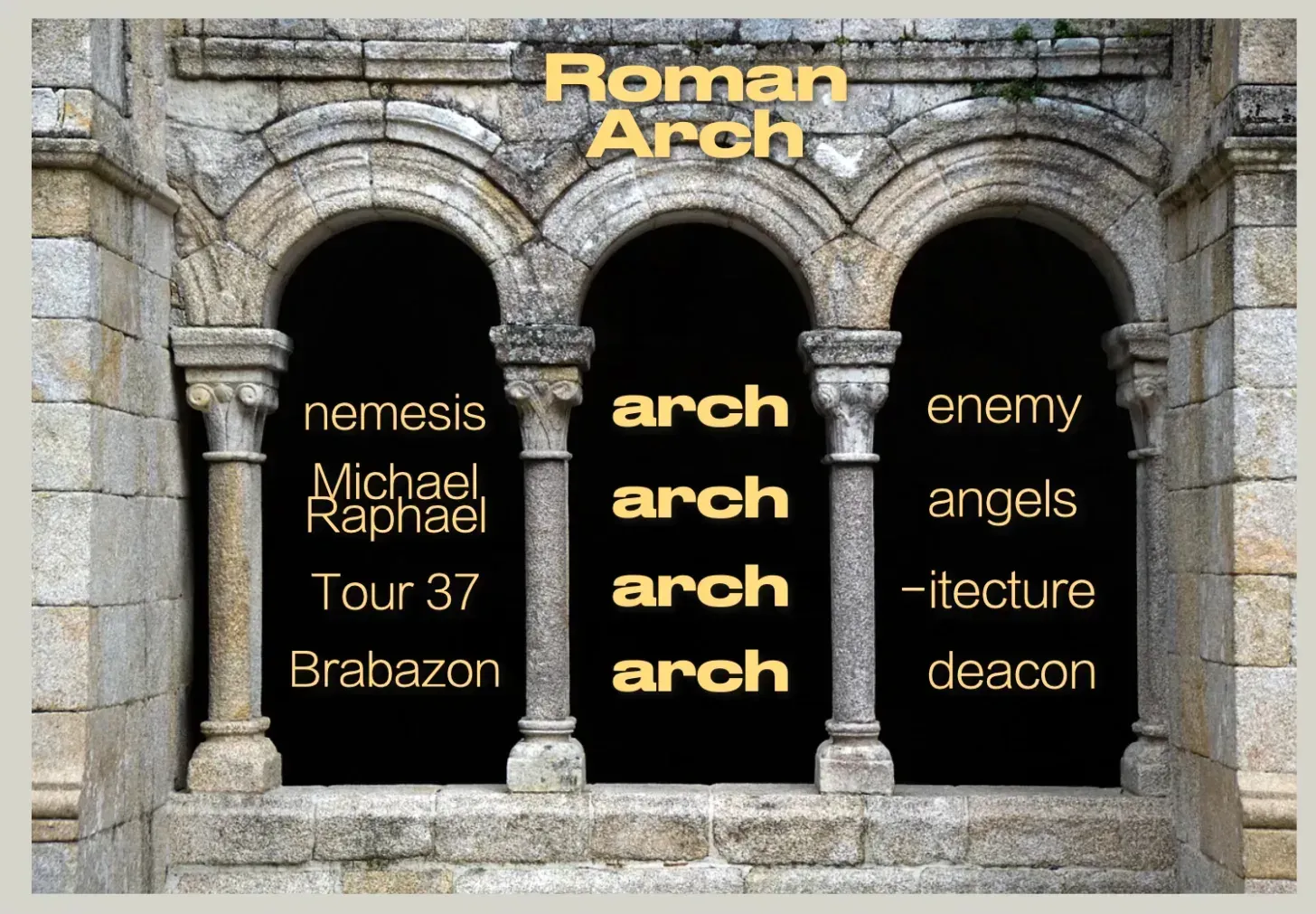
Finally, Archdeacon Brabazon appears as a character in a very similar role to that of Friar Laurence in Romeo and Juliet, as the clergyman consulted to marry Michael Rafiel and Verity Hunt. The name Brabazon means mercenary or hired assassin, which could cast all sorts of weird aspersions on Friar Laurence and his chymical potions… or maybe on the act of incorporation, itself.
Juxtaposing all of these arches in Christie’s Nemesis is the concept of “an-archy,” first mentioned in Chapter 20 when Emlyn Price is described as “anarchistic.” Of course, anarchy means opposed to rulers or archons, and because governance as a concept is “over-arching,” it can be symbolized by the Greco Roman arch, itself.
But what if anarchy means something more than simply being opposed to rulers? Being opposed to the arch, itself, could be symbolized by its geometric opposite: the valley or pit. And so, the name of Christie’s anarchist, Emlyn, which means valley, could be symbolizing a geometrical opposition to arches.
According to the Theoi Greek Mythology website, the combination of the sky’s arch and the underworld’s bowl frame reality, itself: “Tartaros was envisaged as the opposite of the sky, an inverted dome lying beneath the flat earth. Together the Ouranion-dome [Ouranos being the primordial god of the sky] and Tartarean-pit enclosed the entire cosmos in an egg-shaped or spherical shell.” The arch and pit are each half of the whole. Alexander Pope described the force creating them as the ambitious hill scaling the heavens, or that which scoops out the vale. Stacked, they form the egg-shaped sphere, and offset, they form the sine wave.
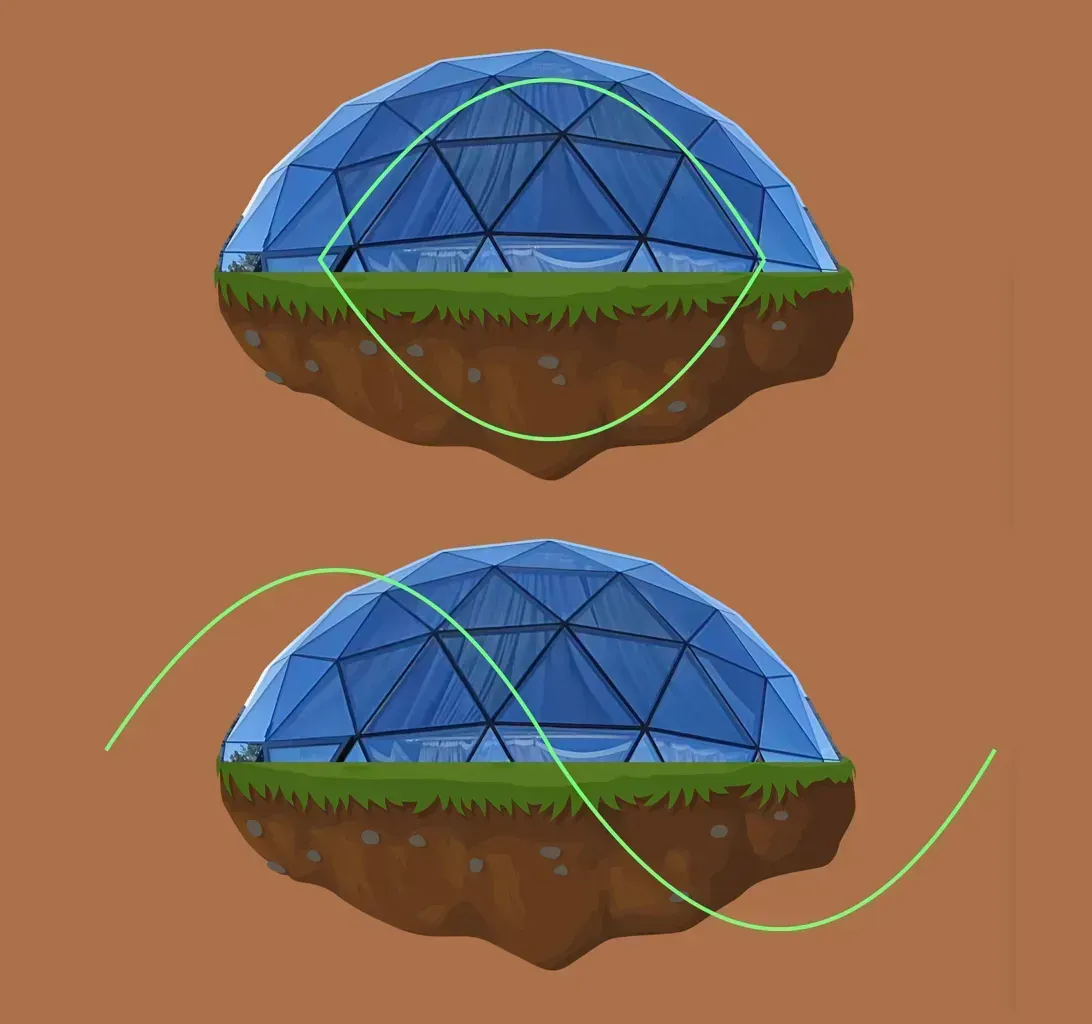
But Tartaros has a much deeper connection to Christie’s novel because Tartaros was the primordial god romantically coupled to the Greek goddess, Nemesis. In fact, the couple had several children known as the Telchines. They were cultivators of the soil and were said to have invented metal-working. Tartaros was also the personification of the place known as Tartarus or hell, the abyss, the underworld. And because he’s a place personified, he fully expresses the concept of genius loci, the spirit of place.
Tartarus, as place, was not just a low area of land, but also a place of banishment. Coincidentally, the banishment of Romeo is foreshadowed by Friar Laurence when he speaks of Titan’s fiery wheels, as Tartarus was the place to which the Titans were banished.
In the play, the word “banished” is emphasized by Juliet as “one word” in Act III, Scene 2: “Tybalt is dead and Romeo banished, that banished, that one word banished…” We see the same phrase, highlighting the “one word” in Nemesis, but here, there are two “one word”s. The first is defined by Miss Marple, who spoke the one word“nemesis” to Jason Rafiel. The second was defined by Elizabeth Temple, giving the one-word explanation for Verity’s death being “love.”
And who was the love interest of Nemesis? Tartaros, the deity and place of banishment. When you’re banished, you must leave your community, your group, your society. You are ceremonially unbound.
In Part 2, we’ll look down one more literary rabbit hole, courtesy of Jules Verne, with a surprise appearance by the Beatles.


Stephanie McPeak Petersen
Join me on deep dives into Shakespeare, Francis Bacon, harmonics, economics, and hidden history.


My husband Allan's website:
Stay connected with my updates delivered straight to your inbox.