
Tartarus: the Genius Loci, part 3
[This article is also available as a video.]
When we left off in Part 2, John Lennon had written a quiet, little song about the act of remembering places before people. He wrote that song in 1965. Three years later, he went a bit further in the lyrics of “Glass Onion,” saying:
I told you about strawberry fields
You know the place where nothing is real
Well, here's another place you can go…
Wikipedia tells us Lennon wrote these lyrics to confuse people… an interesting word, similar to the word incorporate, as confuse is based on the past participle of a Latin word meaning “mingle together,” using the root fuse, as in “fusion.”
As mentioned in Part 2, Strawberry Field was a children’s home for quasi-orphans in the Liverpool neighborhood where John Lennon grew up. As a child, John used to play on the Strawberry Field grounds or desmesnes, a term we’ve used throughout Parts 1 and 2 of this series that means "an estate of land," and that’s evolved into the modern word “domain.” But Strawberry Field wasn’t real to either John or the orphans living there because it wasn’t inheritable as “real estate.” Once enrolled, the young orphans had legal “use” of the land—they could be there, play there, sort of like a public park—but they had no claim on Strawberry Field as an estate of land, as real estate, because they were not its heirs.
Historically, heirs were a different strata of people. In England, land grants were sometimes made by the king or queen to reward military service, but generally you had to be someone fairly important to be granted land. Recall that in Part 1, we briefly touched on the land grant given to Edward Shelley by Henry VIII in 1540 and the kerfuffle that followed. Edward Shelley had some standing in the realm and held favor with the king. He was a member of the gentry and was the brother of William Shelley, a justice of the common pleas. This gave him standing or status making the land given him an estate that was real and inheritable because of his fee-simple ownership.
The term real estate originally meant a royal grant of land based on the receiver’s status in the realm, a realm being a royal area, also with the root “real.” The etymology gods have shifted away from linking the real of real estate with the word royal, having derived from the Spanish word for royal, which is “real.” But if you’re familiar with my work you know that I distrust many mainstream etymological explanations. In this case, the etymological shift is easily disproven, a shift that now claims that the real of "real estate" simply means it’s fixed or immovable land as opposed to personal property, like furniture, that can be moved. So let’s look at this more closely.
Noah Webster makes the same distinction in the 1828 edition of his dictionary, that property is either “real” or “personal,” and that “real estate consists in lands… which descend to heirs.” Personal property, according to Webster, is movable wealth called “chattel.”
This suggests that chattel is separate and distinct from real estate property, and that would be true if real meant "fixed." But it never meant "fixed"; it meant "royal," and we can verify this in Francis Bacon’s Elements of the Common Lawes of England of 1636. On page 43 of “The Use of the Law,” which is the book’s second part, Bacon refers to chattel “reall” which is “chattel royal”: movable wealth going back to the legal executors or administrators working on behalf of the crown. Real chattel hasn’t suddenly been made “real” because it’s now somehow connected to the immovable ground. It’s made real when it reverts back to royalty.
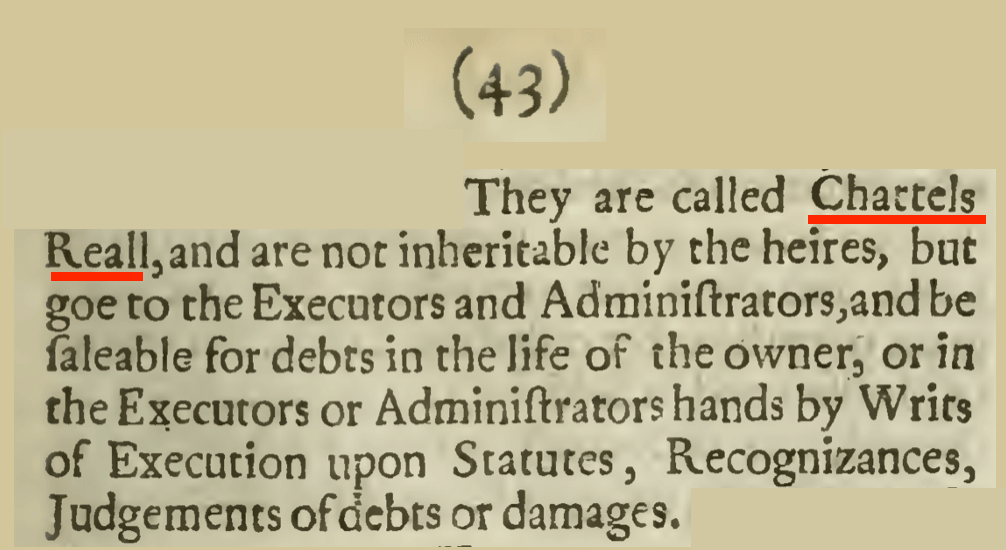
And that’s what the term real estate is saying, that all land was once part of the royal realm but is now being held by someone else at the pleasure of the king. Not all chattel was real or royal originally, but all land was, and Bacon explains why on page 30 of “The Use of the Law”: “The reason why all land is holden of the Crowne immediately or by Mefne Lords, is this. The Conqueror got by right of Conquest all the land of the Realme into his own hands in demeafne.” Interestingly, William didn’t confiscate the land in Kent, the area where gavelkind was in force, allowing for multiple heirs rather than primogeniture that we discussed in Part 1.
The word estate comes from the French estat meaning "status," and you must have some status to hold land, either as gentry, as a knight, or as an heir. Since orphans cannot be heirs, nothing in Strawberry Field was real; they could use the land but they couldn’t inherit the land.
Now, let’s look at the song, “With a Little Help From My Friends,” and this cryptic line:
What do you see when you turn out the light?
I can’t tell you but I know it’s mine.
When the Beatles turn out the light they can’t tell you what they see because it’s now dark, but whatever it is, they know, as members of the masonic elite, its theirs. They are heirs at the elitisit level and we’re shown this in Jules Verne’s Floating Island. In the story, the French take their jurisdiction with them everywhere (show quote again). The same was true in corporate Britain. The Beatles weren’t French, of course, but they’re “on the bus” (in this case, on the ship or floating island), so everything they see is “real” as in “real estate” and ownable. And their jurisdiction extends to wherever they happen to be; it’s not confined to specific coordinates. It’s everywhere and nowhere—a nowhere land. But it’s still real because the extension of jurisdiction is an extension of the real realm.
If you’d like to experience the world as real, but you’re not a member of the gentry or an heir, being rewarded for military service might be an option. In fact, this has been the incentive to populate or “member” military companies since war began. Bacon mentions this in part 2 of his Elements, saying that to the nobles, Knights, and Gentlemen the king gave great rewards of land, and that those landholders enjoying Knights service should “still be conserved in warlike exercises.”
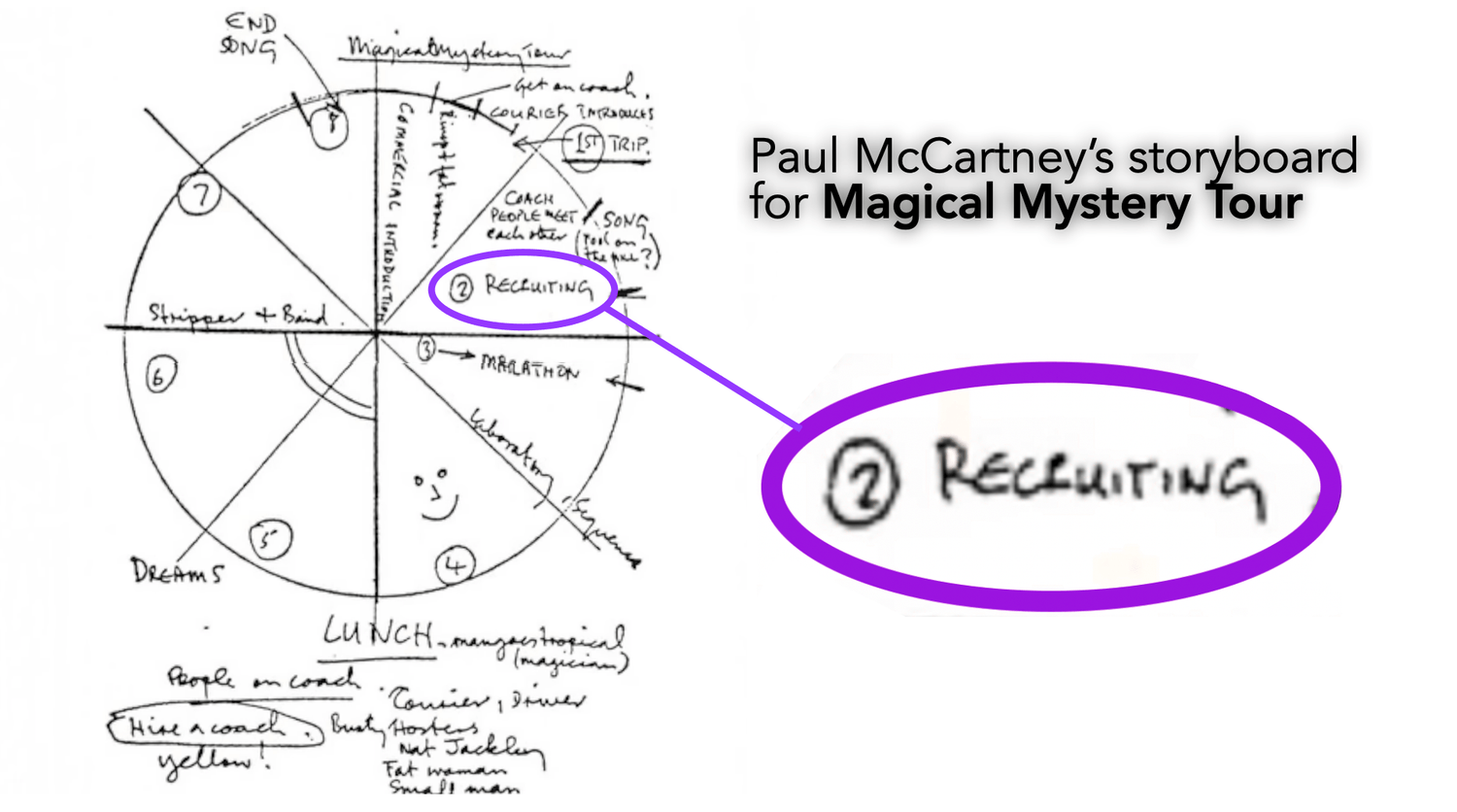
And when re-membering the army moved from conscription to voluntary recruitment, the elite had to find better incentives to talk the boys into fighting. That’s where the Beatles come in; they were to be part of that recruitment effort promoted to the legal orphans and non-heirs of the realm. Notice that when Paul McCartney first maps out the circular story line of the Magical Mystery Tour, the word “recruiting” appears prominently up near the beginning. If you doubt such anti-war activists as the Beatles could be involved in military recruitment, stay with me, because you’ve been lied to.
This trip is a coach tour, not terribly different from Miss Marple’s Tour 37 of famous houses and gardens, which—it’s important to note—was published by Agatha Christie in 1971, four years after Magical Mystery Tour was broadcast on British television screens. The Magical Mystery Tour wasn’t a movie in theaters that the audience had to pay for. The controllers wanted the masses to see Magical Mystery Tour because it was a major piece of propaganda.
For those who bought the double EP of the six songs in the TV movie, a booklet was included that story-boarded the tour, and we’ll be looking at some stills from that as we go. The artwork was done by Bob Gibson, who explained his work this way: “I simply tumbled ideas into each box, filling every scene with confusion and — I hope – maximum interest value for children of all ages.” So here we have another content creator, if you will, pushing confusion (fusing or joining) in his art.
The coach tour starts with Ringo and his aunt Jessie, a call-back to John growing up as a quasi orphan with his aunt and uncle. Later, Paul is daydreaming that he’s up on a hill, an elevated piece of land (useful for a monument), though in the booklet, it looks a lot like a barrow (useful for a grave).
When the group arrives at the military recruitment office, the booklet says they’re instructed, “[I]f they try to get you to join up (incorporate into the corps) DON’T TAKE ANY NOTICE.” In law, if you accept or “take” a notice, it’s similar to accepting a summons. Taking a notice or summons is the same as being served.
And this all seems to coincide with the Beatles’ stated opposition to war. But it really doesn’t matter what the Beatles tell your conscious brain. It matters what they tell your subconscious brain, with the imagery in their films and album covers or the distorted muscial tunings in their music or what they do rather than what they say. It turns out only John was really opposed to war and the corporate state, because he was the only Beatle to give his MBE back. Because, yes, all four Beatles became Members of the Order of the British Empire in 1965, and John held onto his for four years.
The Order of the British Empire is an award given to either military or civilian individuals, and the Beatles were civilian recipients, but either way, the Order is a quasi military organization and the Beatles were not rewarded by it for promoting peace.
We need to be aware of who these people really were. John played along for a while, giving the masonic hand symbol, along with Paul who holds a knighthood, which is an even higher rank in this quasi militaristic system than either an MBE or an OBE. Who were the knights? They engaged in combat and performed “warlike exercises.” George Harrison was offered an OBE after his MBE, but George turned this down because he felt he deserved a knighthood like Paul received. He died before all that could get sorted out, and Ringo, he was knighted just a few years ago, in 2018. Knowing all this, how solid do you really think the Beatles anti-war stance was?
Yes, the Beatles are civilian members of the Empire, and the MBE award originated during WWI for military and civilian service, but the service of civilians was described as taking place “not on the front line.” Civilians can absolutely help the war effort from other locations than the front line. Do you really think the British Empire valued the Beatles’ “service” in writing and performing the song, “Please Please Me”? No. The band was groomed from the start to perform a specific service, “not on the front line,” for the perpetuation of the British Empire, and if we drill down a little deeper, we can see that service being walked out in the Magical Mystery Tour.
Remember, national service ended in England in 1960, just before the Beatles really got going. National service was military conscription, the “duty” of the boys living in a municipality who grew up beating the bounds to “re-member.” One reason conscription ended was because of the people’s opposition to this draft, so recruitment efforts had to become more covert.
This scene wasn’t meant to prevent military recruitment or talk the boys out of it. It was meant to lower resistance to the process by mocking it, making it look silly and irrelevant and something to ignore… removing it from everyone’s awareness or notice so that the population would have less resistance to it.
Ultimately, the Beatles were climbing on a band wagon of farcical war movies of the 1960s, taking the idea of the military away from war and death and pushing it into comedy and schtick. According to Google AI, war movies didn’t start to be funny until—you guessed it—the 1960s, right after national service was ended and recruitment became necessary.
And this is exactly what Lester’s movie, “How I Won the War,” was up to, turning war into a silly experience that wasn’t threatening so much as it was absurd. Even death was handled absurdly in this movie.
And seeing the Beatles in military garb, even as farce, is useful when communicating to the subconscious.
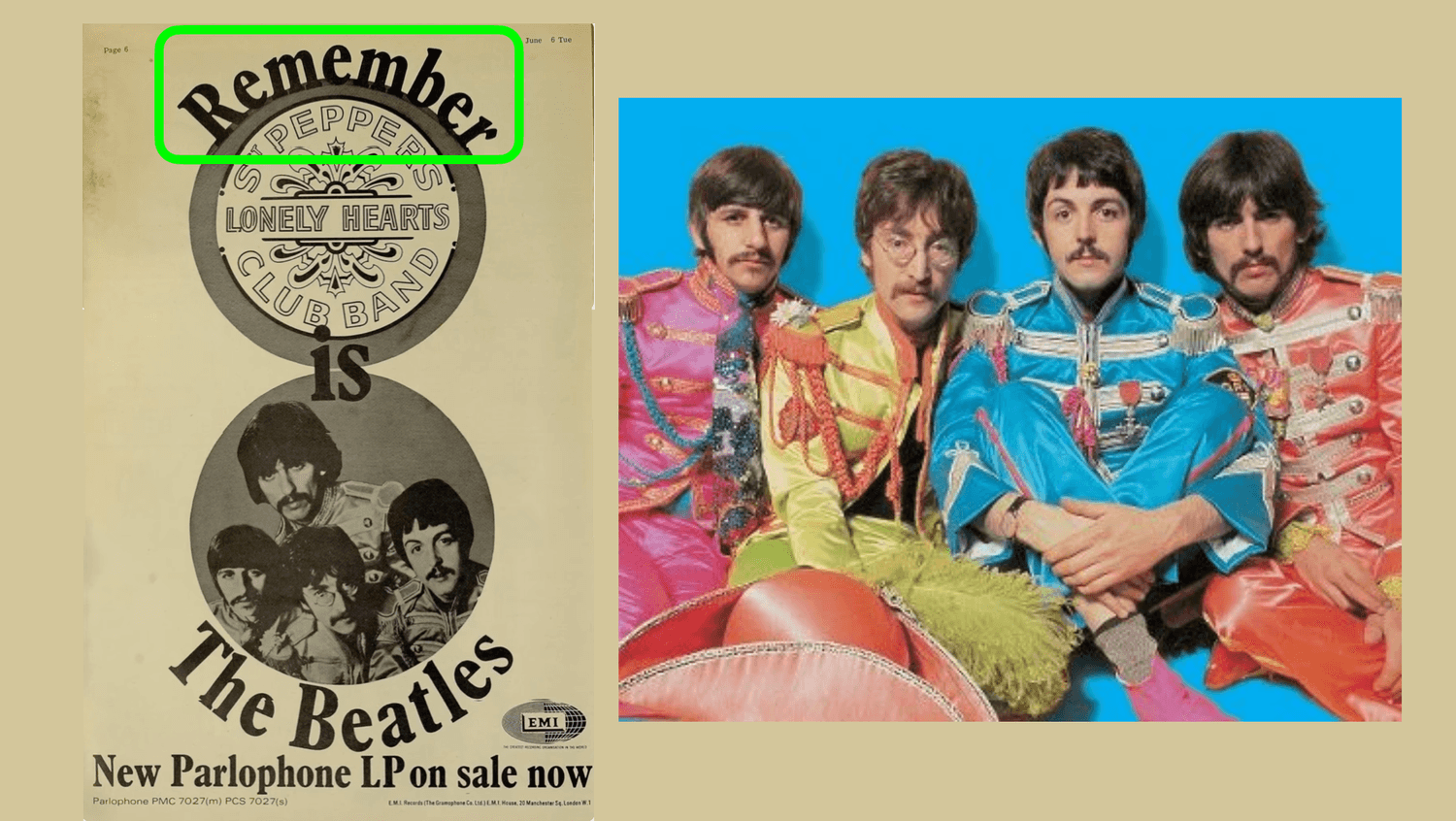
uniforms
In 1963, the Beatles covered the song called “Till There Was You.” It was released on their second album, With the Beatles, and they also performed it live at the Royal Hall.
The song was written by Meredith Willson for his magnum opus, The Music Man; the film version of that was released the year before, in 1962. That film starts with a military marching band and a very military sounding drum corps. This was American propaganda intended to soften the public’s perception of anything military… no foxholes, no guns, just an upbeat military-looking band, comedy, and a pretty, singing girl… all in bright technicolor.
Both Meredith Willson and Robert Preston, the film’s star, were involved with government propaganda. Willson was the musical director for the Armed Forces Radio Service and produced “radio material” for the Office of War Information. Willson also wrote “Chicken Fat” for JFK’s program of physical fitness (sung by The Music Man’s Robert Preston) and the song “WIN” for Gerald Ford’s campaign, “Whip Inflation Now.”
Preston appeared in several propaganda films to boost recruitment including Parachute Batallion. He also narrated Sentinels in the Air, a short recruiting film put out by the Air Force Reserve in 1956.
In The Music Man, Preston plays a man named Gregory who calls himself Professor Harold Hill. He’s a conman traveling from town to town selling snake oil and then skipping town with the cash. But the snake oil he’s selling is very unusual: he’s selling boys bands and he’s selling uniforms. When he describes this “boys band,” he pulls four names out of a hat as examples of boy musicians: Johnny, Willie, Teddy, Fred. It almost makes it sound like he’s forming a pop group, but that wouldn’t sell enough uniforms for Hill’s larger vision. No, he’s forming a boys marching band.
But it’s the uniforms that are important, as he tells his friend: “when the uniforms arrive they forget everything else—at least, long enough for me to collect and leave.” He’s not selling anything musical; he can’t play, read, or teach music. He’s selling an appearance. And by the time the town re-members, he’s long gone.
Five years later, the Beatles would show up as an established boys band in similar uniforms, and—I would argue—a similar task: to link the military with upbeat music to lower the public’s resistance and increase recruitment. Notice that Hill mentioned little green apples? The Apple Records label the band put out in 1968 was owned by a parent company called Apple Corps with a military play on words: the term corps, meaning “the main subdivision of an armed force in the field.”
And don’t forget the double meaning of these words: in promoting boys bands, a word that can mean a group of musicians, they’re also promoting bands as strips of fascia that bind boys in a “band” of brothers or a military company.
So how does all this relate back to the genius loci and the importance of place? First of all, Hill drums up demand for a “boys band” by warning the people of River City that their boys will be “frittering” their time away on the town’s new pool table, a situation that sounds very similar to the one described by Frederick Law Olmsted—the genius of outdoor space—in his speech warning of young men’s vile pasttimes in basements, and of the solution to be found in public parks. Hill explains all this to the people of River City as they gather in the public park of River City, Iowa, a town patterned after Willson’s hometown of Mason City, Iowa. And yes, Mason City refers to freemasons. The town was founded in 1853, one of the masonic numbers we keep encountering. And according to Wikipedia, “The town had several freemasonic influenced names: Shibboleth, Masonic Grove, and Masonville until Mason City was adopted in 1855.”
Wikipedia goes on to say that Mason City is “known for its musical and masonry heritage.” This is an interesting link for Wikipedia to make because this link is not widely understood, but in The Next Octave I show that, in ancient times, brick layers were dubbed “mesons” because they offset their stacked stones at the center, the musical mese of ancient Greek music. Freemasonry later facilitated the tuning system of equal temperament, which was perfected using the masonic tools of a straightedge and compass.
The masonic connection to Rosicrucian thought is also hinted at in the lyrics of Meredith Willson’s song, “Till There Was You,” that the Beatles covered:
There were bells on a hill
But I never heard them ringing…
Bells on a hill could easily describe a monument or temple on an elevated piece of land, and it’s interesting that Willson gave his musical con man the last name of Hill. (show slide of McCartney as fool on the hill)
Then there was music
And wonderful roses, they tell me
In sweet fragrant meadows
Of dawn and dew
This is a song about awareness, or the lack thereof. Many people go through their daily lives without ever hearing the bells on the hill, without hearing the music (for what it is), without being aware of the symbolism of the roses, the dawn, the dew. Because of this, I suspect the lyrics are hiding something: the word you could be standing in for the homophone yew, a tree that’s highly poisonous and its pollen, when inhaled, can be hallucinogenic, creating altered states of consciousness that often expand awareness.
The words roses, dawn, and dew clustered together in this verse are specifically alluding to Rosicrucian elements. In my book, The Alchemical Solfeggio, I discuss meaning of dew to the Rosicrucians, which was “solvent.” Hidden in the first two Dutch words of the Fama Fraternitatis is the English word “dew.” The Latin word ros, refers to the alkahest, a universal solvent, or universal dew that’s sought after in alchemy. The Rosicrucian member Peter Bindon has written that “rose” was “an alchemical code name” for the solvent of tartar, which takes us back to the symbolic role of Tartarus in alchemy. So Rosicrucianism helps us see the concave pit of Tartarus as a cup, or crucis holding tartar, the alkahest or universal solvent called dew.
And this brings us abruptly back to the Magical Mystery Tour where we find another, very prominent reference made to dew, when the tour bus is being tracked: “ten miles north on the Dewsbury Road.” Dewsbury, as well as Leeds (ten miles up), and even the band’s hometown of Liverpool, are all on the 53rd parallel north. Like the search party in Castaways made a trip along the 37th parallel south, the Beatles are making a trip along the 53rd parallel north.
Back in River City, Iowa (that lacks masonic coordinates but is based on a masonic name—place vs. name), the band uniforms are about to arrive, and the uniforms tie in to a line from “Lovely Rita” on Sgt. Pepper:
In a cap she looked much older,
And the bag across her shoulder
Made her look a little like a milit’ry man
Because the clothes make the man (or woman), I would argue that The Music Man, the Magical Mystery Tour, and Sgt. Pepper are all attempts to get boy or girl musicians into military garb.
According to research done by Stacy on Mike Williams' Paul Is Dead channel, the Beatles’ fictional sergeant known as Pepper was likely a combined characterization of both John Philip Sousa, a sergeant in the Marines, and J.W. Pepper, a publisher of sheet music. On Pepper’s company souvenir from the Chicago World’s Fair, it boasted “$20,000 worth purchased by the U.S. government.” Pepper built the first sousaphone for John Philip Sousa and Pepper happened to be born in 1853.
But it was Sousa who was the king of musical military marches. In 1881, Wikipedia tells us that Sousa was initiated into freemasonry at the Hiram Lodge No. 10 in Washington, D.C.
But although the Beatles wore the colorful military band uniforms in Sgt. Pepper, only Paul wore military garb in the Magical Mystery Tour. Instead, the uniform of that film that all the boys wore was the white tuxedo, accessorized with three red carnations and one black. I’m not as interested in their colors (other people have covered that angle at length); I’m more interested in the type of flower the Beatles are wearing: the carnation.
There is some disagreement about what the word carnation actually means, but the Latin root, carnis, means “flesh,” and not surprisingly, the word carnation is just two letters away from the word incarnation, meaning to be made flesh, to be put into flesh… to be born. From here, the word re-incarnation means to be born again, to be made flesh all over again after having previously done so.
The elites often wear a boutonniere with a tuxedo of either a rose or a carnation, because of each flower’s specific symbolism: rose for the solvent of tartar or carnation for being born into flesh. And to understand why the Beatles chose to wear carnations at the end of the Magical Mystery Tour, we need to go back to their roots in Liverpool, to the area in which they were born.
infantry incubators
Recall that just across the river Mersey from Liverpool is the town of Birkenhead, the most progressive place in the world in the view of Frederick Law Olmsted, the genius of outdoor place, and Charles Loring Brace, the man who organized the slave labor placement of orphans.
Now, for me, the word progressive is not a positive one. I’ve done research for decades on how progressive thought and progressive policies have created several economic problems that have increased the divide between rich and poor rather than decreased it—things like the minimum wage, which causes the layoffs of the very employees it’s supposedly intended to help. Of course, the minimum wage law wasn’t just a stupid economic policy that backfired; the law was passed on purpose to target layoffs of black employees in the 1930s. This racist agenda has been well documented.
And one of the most “progressive” ideas ever was something called eugenics, a word we don’t even use anymore because it’s so negatively charged. Encyclopedia Brittanica tiptoes around the term to define it as politely as possible: “The term eugenics was coined in 1883 by British explorer and natural scientist Francis Galton, who, influenced by Charles Darwin’s theory of natural selection, advocated a system that would allow ‘the more suitable races or strains of blood a better chance of prevailing speedily over the less suitable’.” Eugenics was, in effect, racism plus population control (rebranded as a “choice” that all progressive women should want to make) and it spawned Margaret Sanger’s Planned Parenthood. (That Sanger believed in eugenics is openly admitted on the Planned Parenthood website.)
Just in case you doubt how progressive these policies were, Michael Freeden, writing in The Historical Journal, explored the attraction eugenics held for progressives. The well-known progressives of the time were people like George Bernard Shaw, H.G. Wells, Winston Churchill (the face of World War II), and Churchill’s best friend, Frederick Edwin Smith, who was born in Birkenhead. He’s maybe less well known but was no less powerful. Smith was the Lord High Chancellor of Great Britain and became the 1st Earl of Birkenhead in 1922. Because of this, he’s actually referred to as “Birkenhead.”
In 1930, Birkenhead published a futurist book called, The World in 2030, in which he wrote this: “By regulating the choice of the ectogenetic parents of the next generation, the Cabinet of the future could breed a nation of industrious dullards… A further immediate consequence of ectogenesis would be a plea that society should be allowed to produce the human types it most needs, instead of being forced to absorb all the unsuitable types which happen to be born… Many of the arguments brought against slavery would be powerless in such a case; for the ectogenetic slave of the future would not feel his bonds.” (p. 15-16) This quote is eugenics on parade and Aldous Huxley would depict the idea just two years later in Brave New World.
In his book, Birkenhead was hoping that, in the future, eugenics could benefit from the technology of ectogenesis, which refers to the process of growing babies outside the body of a woman, for example, in a test tube and incubator.
At the end of the 19th century, incubators displaying infants were all the rage at world’s fairs. Sideshows like “The Child Hatchery”charged admission to see premature babies under the guise of generating “funding” for neonatal research. Dr. Martin Couney’s “Infantorium” was located on Coney Island, which sat not on the 37th parallel, but its inversion, the 73rd meridian.
But the fact that Couney was only posing as a doctor suggests that the ectogenetic technology of the day was less than noble, perhaps something more akin to what Birkenhead described in The World of 2030. It’s possible that the incubator craze decades earlier was more than simply about a technology to produce “dullards” or even ectogenetic slaves. It may have also been an attempt to mass produce soldiers by mass producing infants.
And this is where we see an unexpected connection between the Earl of Birkenhead’s promotion of ectogenesis, right next door to Liverpool, where the Beatles were born 20 years later, and with both towns sitting on the 53rd parallel. Those carnations on the Beatles’ tuxedoes at the end of the Magical Mystery Tour symbolize being made flesh, coming into being through birth.
The word carnation is also similar to the Gaelic word carn, meaning a “heap of stones,” and from which the Scottish word cairn derives. A cairn, like a barrow, is a monument, something we looked at in Part 1. Dictionary.com defines a cairn as a “memorial.” But a cairn only has the skeleton of a barrow monument. It lacks the soil covering it, the flesh of the barrow. So while a barrow is a monument to death, we might see the cairn, the dolmen, and even standing stones, as monuments to birth, the greatest of all portals into physical reality.
Many esoteric researchers, even today, describe dolmens and standing stone circles as portals in their own right. In a video collaboration, Michelle Gibson talks about Aleister Crowley, shown here on the Sgt. Pepper album cover, passing his infant son through a circular megalith at Mên-an-Tol in Cornwall, and there have been other legends of infants being passed through this stone, mostly for the purpose of healing.
Perhaps such megaliths are memorials meant for more than simply thinking about the dead, but of symbolically re-membering or recalling the dead back into the corpus of the living. Perhaps a cairn is a portal for incarnation, essentially re-populating the world through such portals, specific places marked by mounds, bounds, hills, ley lines, even coordinates—the genius loci—where we re-member the Earth through symbolic birth.
And at this point, I should probably apologize for sharing misinformation in this video. In fact, I must apologize for letting it go this long, because I had to fully explore the mainstream narrative, but the truth is that genius loci doesn’t really mean “the ‘spirit’ of place” (and this is why it pays to watch my videos to their conclusions). If we look at the etymology more critically, we find that the Latin word genio means to be born, from the root word beget. The genio loci of ancient Rome means, literally, a place of birth… a birthplace.
A genius is an act of creation, of incarnation. Its root, gen is found in others words like gene, genealogy and primogeniture. It’s the creation of a generation of children, the same process of sending new souls to incarnate on the earth that Plato describes in the Myth of Er. However, the child’s “genius” wasn’t an attendant, regulating divinity; it was the child’s birthplace, its birth location, the coordinates at which the child entered the earth grid. In astrology, the location of a person’s birth is important because, along with the time of birth, it determines the “ascendant” in the birth chart. According to Google AI, “Your birthplace’s latitude and longitude pinpoint the exact placement of planets in your birth chart’s 12 houses, which represent different areas of life.”
So all of this: the orphans and anarchists in the valleys or pits, the Roman arches of hills, the inability to inherit land, the legal fight over the name vs. the place of a corpus or corporation, the ley lines / bearings / and beating of the bounds, and the tours along the 37th and 53rd parallels have all been a recurring attempts to quietly recruit a new generation of infantry, defined by Google AI as, “the soldiers who fight on foot and are the main land combat force in the military” that capture and hold territory. They can’t inherit the land, but they can hold onto it for the warlord.
Google AI tells us that, “The term "infantry" comes from the Latin word infans, meaning “unable to speak” or “child.” In Renaissance Italy, infante referred to a "youth" or "foot soldier" too young or inexperienced for cavalry, leading to the military term infanteria, which entered English via French around the 14th century. Today, infantry refers to any soldiers who fight on foot, regardless of their age or experience.” As such, the military term “infantry” pertains to the youthful nature of the members in this company of soldiers. The military term “troop” (836) can mean to walk—travel on foot—but it’s also used to define a company or group of soldiers in war… not to mention a troop of boy or girl “scouts”: the grooming of children to enter war-like companies, earning pins and patches to display on brown and green uniforms, the colors of camouflage.
The link between a war victory and the foot even takes us back to Romeo and Juliet, as Romeo’s mother cautions him in Act I, Scene 1: “Thou shalt not stir a foot to seek a foe.”
War starts with the foot.
Jules Verne gives us similar imagery in the 21st chapter of The Children of Captain Grant: “Manuel could not conceive of any state but a military one, and he hoped in due time, with the help of God, to offer the republic a whole company of young soldiers. ‘You saw them. Charming! good soldiers are Jose, Juan, and Miquele! Pepe, seven year old; Pepe can handle a gun.’ Pepe, hearing himself complimented, brought his two little feet together, and presented arms with perfect grace.”
In light of the nature of a fighting “infantry,” the story of the pirate Blackbeard takes on possibly new meaning. According to Cort Lindahl, Blackbeard was hung along with twelve of his crewmates in 1719 at Williamsburg, Virginia. His skull was then raised on a pike at the entrance of Hampton Harbor, sitting exactly on the 37th parallel. Years later, this skull was said to have been silver plated and used as a punch bowl known as “the infant.” To turn the dome of a skull into a basin is to invert the hill into a valley, and is a symbolic move from the head to the foot. There are many ways to kill someone but the symbolism of separating body parts, especially the head, speaks to dismemberment as something even more powerful than death. (show slide of Perseus holding Medusa’s head again) The message of a story of dismemberment, like that of Osiris, is that it’s dangerous to become separated from the corpus, the body, the group.
That the infantry fights “on foot” is a symbol of militarism that goes back to Perseus, who founded the city of Tarsus in Turkey when an oracle told him to build a city where his foot first touched the ground after a victory in war. The resulting city of Tarsus is where the tarsal and meta-tarsal bones of the foot get their name. I was first made aware of the importance of Tarsus by my friend Dane Quirk, Saturn Rooster on YouTube. He pointed out to me that Tarsus sits next to the city of Adana, a symbolic coupling of heaven and hell, with Tarsus being a name close to Tartarus and Adana similar to Eden. You’ll recall from Castaways that another Eden, this one in Australia, sits on the 37th parallel south, while this Eden, Adana in Turkey, is located on the 37th parallel north.
So maybe it’s time to return to Australia and the 37th parallel south to tie this whole story together.
Shrine of Remembrance
As I’ve discussed elsewhere, remembrance is the metaphorical re-binding of a body held together with the fascia membrane: it’s a fascist, corporatist bond. Likewise, the word re-member, or recalling memories, is about re-populating or re-calling (calling back) the members of a group, especially groups that engage in combat. There are hints of this play on words everywhere. Going back to Jules Verne’s Floating Island, we find this one: “Were there any soldiers in Floating Island? Yes, a body of five hundred men under the orders of Colonel Stewart, for it had to be remembered that some parts of the Pacific are not always safe.” It’s saying one thing, but giving very specific imagery when the words are parsed: “a body of men… it had to be re-membered.”
In another video, I also discussed that the rhyme, “Remember, remember the Fifth of November,” is not only a line telling people to memorialize the Gunpowder Plot, but an instruction to re-populate the movement to carry it out. The people on Tour 37 in Nemesis are following a ley line or path that’s rising to the location of a memorial tower, a place for remembering the dead. And on the 37th parallel south, there’s another, very well-known place for remembering the dead killed in war. It’s called the Shrine of Remembrance.
This shrine occupies another position in Australia that’s been the subject of Dane Quirk’s research on his SaturnRooster YouTube channel. Its coordinates cause my work and Dane’s to overlap: the 144th meridian east and the 37th parallel south.
Dane has found alignments of recurring values between the Shrine, the municipality of Eden, the Parliament House pyramid in Canberra, and the lighthouse on Montague Island. For example, Dane noticed that the distance from the tip of the pyramid over Parliament House to the lighthouse on Montague Island was 144 km long. This is 144,000 meters, echoing the number of 144,000 white casing stones on the pyramid in Giza. And as mentioned before, the Shrine of Remembrance, also with a step pyramid over a Romanesque building, sits at the longitude of 144 degrees east.
Dane also realized that the alignment from Parliament House out to Montague Island passes right over a mountain called Mt. Moruya, as well as several large granite megaliths, 10 meters high. Recall that the name Montague means “pointed hill” and the name Capulet suggests a pyramid capstone. Moruya is also a pointed hill, and its name derives from an aboriginal word meaning “resting place of the black swans.” Dane believes this refers to a Viking ship in the shape of a swan that capsized there. You can find more information on this at his SaturnRooster YouTube channel.
What’s interesting in the overlap of our work is the prevalence of these masonic numbers, 37 and 53. In my research, I found that the numbers show up in modern travel distances, too: 553 kilometers from the Shrine of Remembrance to Eden, and 53.5 kilometers or 53 minutes Adana to Tarsus.
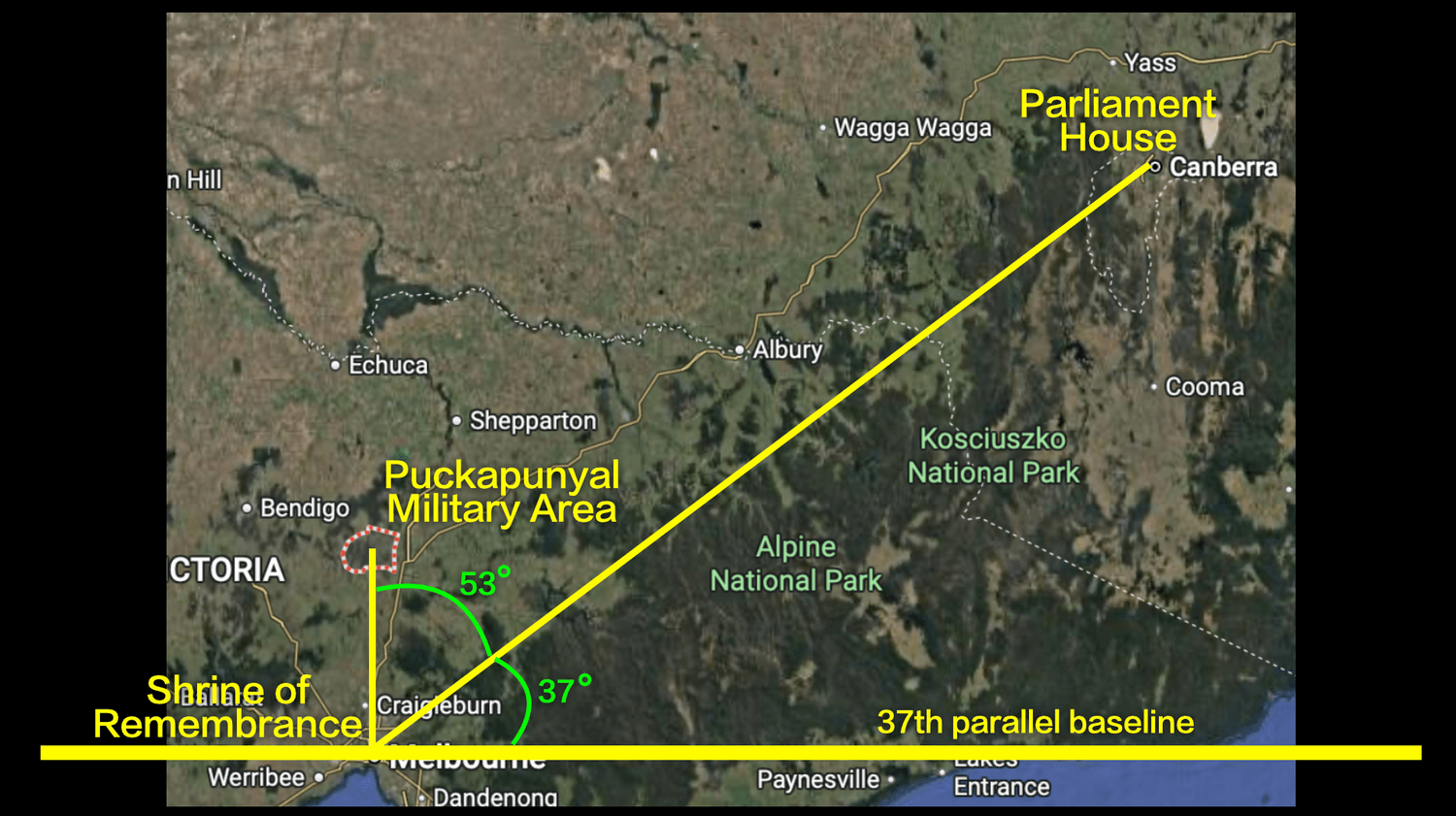
The Shrine of Remembrance is an Australian national war memorial, built in Melbourne on a 50-foot artificial hill. The memorial was dedicated in 1934, which happens to be 37 years before Nemesis was published, a novel that includes a Temple being killed on a monument on a hill. In my own research, I found that using the 37th line of latitude as a baseline, the alignment of the Shrine up to the Parliament House pyramid in Canberra is also 37 degrees. And from the 37th latitude, the Puckapunyal army base sits at a 53 degree angle from the alignment of the Shrine of Remembrance to Parliament House.
One of the statues at the Shrine of Remembrance is called Father and Son. According to the shrine’s website, the statue was “created to honour the courage and sacrifice of 2 generations of Victorians who served and died in the First and Second World Wars. It is symbolic of the service of many Victorian families, in which the father served in the First World War (1914-18) and the son in the Second World War (1939-45).” The implication is clear: for many sons in early 20th century Australia, it wasn’t land, but the legacy of serving in a war that was the inheritance they received from their fathers.
I would suggest that the Shrine of Remembrance, at 37 degrees south and 144 degrees east, was intentionally placed on these symbolic coordinates to create a very specific genius loci or birthplace for a concept: the perpetuation of war. It’s obvious that simply encouraging many minds to focus on war will perpetuate it, but the process goes much deeper than that. A memorial of remembrance is a form of recruitment that binds us with emotions of us vs. them, causing the old to grieve for friends lost to earlier wars, and solidifies the population’s resolve for continuing what feels like their own “principled” fight.
Of course, the Shrine of Remembrance didn’t yet exist when Jules Verne wrote his novel exploring the 37th parallel, but he was doing something similar in The Children of Captain Grant: using the symbolism of Eden—the symbolic birthplace of humanity—to glorify the corporate municipality, which is just another feature of the company, the group, the platoon, the business that dissolves individual accountability in large numbers. You might not convince boys to kill individually, but you can easily convince boys (and girls) to kill when they’re anonymized within a corporate body.
But in a podcast on the Shrine, Dale Holmes and his guest Nikki Penford describe these jagged, angular pits as “sperm / egg.” In fact, Nikki also explains that the model for the Shrine was called the “embryo.”
For me, this symbolism is about re-membering war through the act of birth.
When Dane first shared his alignments in this area, which you can see him talk about on his YouTube channel, SaturnRooster, I asked him if there was anything interesting at the mese point, the center, between Montague and what I see as “Capulet,” the capstone of Parliament House. When he measured it out, Dane found that what sat at the mese point of this alignment was a gigantic pit called the Big Hole. It’s a perfect metaphor, the Big Hole as a concave womb to house the offspring created by the incorporation of Montague and Capulet. This is birth symbolism—the in-carnation on the tuxedo the elites use to encourage recruitment through re-population, but its most important feature is that it’s ectogenetic: this womb isn’t inside Juliet. It’s outside her “body,” her corpus, at the mese between Juliet and Romeo… just like an incubator on Coney Island. Simply by providing the Capulet and Montague context, the controllers were turning the Big Hole into a genius loci, a symbolic place of birth.
And this isn’t the only genius loci to be found in this area. Another ancient “womb” is located here, known as Gulaga, with the modern name of Mt. Dromedary. To the Aboriginals, Gulaga symbolizes the mother and Dane found that the alignment between Montague Island and the Shrine of Remembrance (the sperm, the egg, the embryo) passes straight through Gulaga without any deviation. According to Wikipedia, Gulaga “holds particular significance for Aboriginal women. For the Yuin people it is seen as a place of cultural origin. The mountain is regarded as a symbolic mother-figure providing the basis for the people's spiritual identity.”
Gulaga is located on the 36th parallel south. The number 36 is not masonic; it’s harmonic. It’s a multiple of 9 and represents the 2nd octave of D, which is Harmonic 9. For the purpose of birth symbolism, the 36th latitude would have been a harmonic, healthy place to symbolize birth, though there’s no evidence that the Aboriginals acknowledged modern latitudes. But the controllers do acknowledge them, and they also distort harmonics, which is why the numbers in the masonic logo are 37 and 53, rather than 36 and 54. You can see that the interval they form is a distortion of the perfect 5th between D and A.
But the Aboriginals weren’t only focused on female birth symbolism. Gulaga was the mother of two sons, one of them being Barunguba, the land mass of Montague Island, which was also on the 36th parallel south. Dane learned from an elder that Montague Island was historically a place for young male initiation. And going back to Perseus, the demigod who founded Tarsus by placing his foot on that location, Google AI tells us that the Perseus cult (which was the religion worshipping him) focused on specific male initiation rites: “These rituals involved tests or contests for young men to prove their worth and move toward full citizenship.” Google goes on to say that the process of adolescent male initiation generally involves fostering a new identity with a focus on “responsibility to the group.” A group can also be described as a company or a corporation. This is the same initiation rite the Shrine of Remembrance is attempting to conjure on the 37th parallel south: fostering an identity defined by a responsibility to the group and moving toward full citizenship: they want young men coming to the Shrine with their families to feel a strong call of duty—a remembrance—emanating from this genius loci.
Aboriginal women weren’t allowed on Barunguba (Montague Island), at least during these male initiations, and the females would instead congregate on Gulaga, as their genius loci. Likewise, when the Shrine of Remembrance first opened, women were not allowed into the building, despite the fact that many mothers and girlfriends had many “remembrances” of their lost loved ones. But the Shrine wasn’t really about the memories of lost soldiers in the hearts of their relatives. It was about the literal re-populating and re-binding of military companies as a male initiation rite.
palingenesis
Fascism is the ultimate expression of the corporate form: a generation bound to one another. Remember Miss Marple’s “fascinator” from Part 1? To fasten or fascinate is to bind or clasp together, and her fascinator gave Miss Marple a “remembrance” right at the outset, in Chapter 1 of Nemesis.
The purpose of a re-membrance is to re-populate the company of anonymous members because, when the corporation acts as one, its individual members are no longer liable for what the group has done.
According to Wikipedia, fascism is concerned with a concept called “palingenesis,” which is a national re-birth or re-generation: a birthing process on the macro scale, or the birthing of groups. As such, members of the nation’s re-birthed body are held together by its national fascia, which all just boils down to this: the members can’t opt out. Fascism requires that everyone join in, become incorporated with the nation as a whole. On the micro scale, the members must be born into immediate fascial bonds. It’s not something bestowed when members come of age. Initiation is no longer an issue for adolescents. This is why modern fascism—the incorporation of the world—must start with the infant.
The fascia holds the body members together—its “membership”—and fascism, through palingenesis and re-generation, ensures there’s a new body to hold together when the old body has become completely out-moded. Policies may change but the bonded members are always renewed.
The ley lines of this legal, corporate reality converge in the tragic romance, the play all about the legal inheritance of land, Romeo and Juliet, as Friar Laurence gives the following soliloquy tying it all together: from the birth of the infant through the earth womb or genius loci, to the child’s abiding in the architecture continually ruling over them, their toiling use of the land, until they’re deemed ready to step foot on the battlefield, to see action in the perpetual wars between the earth’s two opposing, feuding houses. Friar Laurence is contemplating the poisonous flower growing from the same earth as those that do the world good, and his commentary on the poisonous flower use words that we’ve studied all along in this video: children/womb/birth … stones/earth/use/residence… and ultimately the word infant.
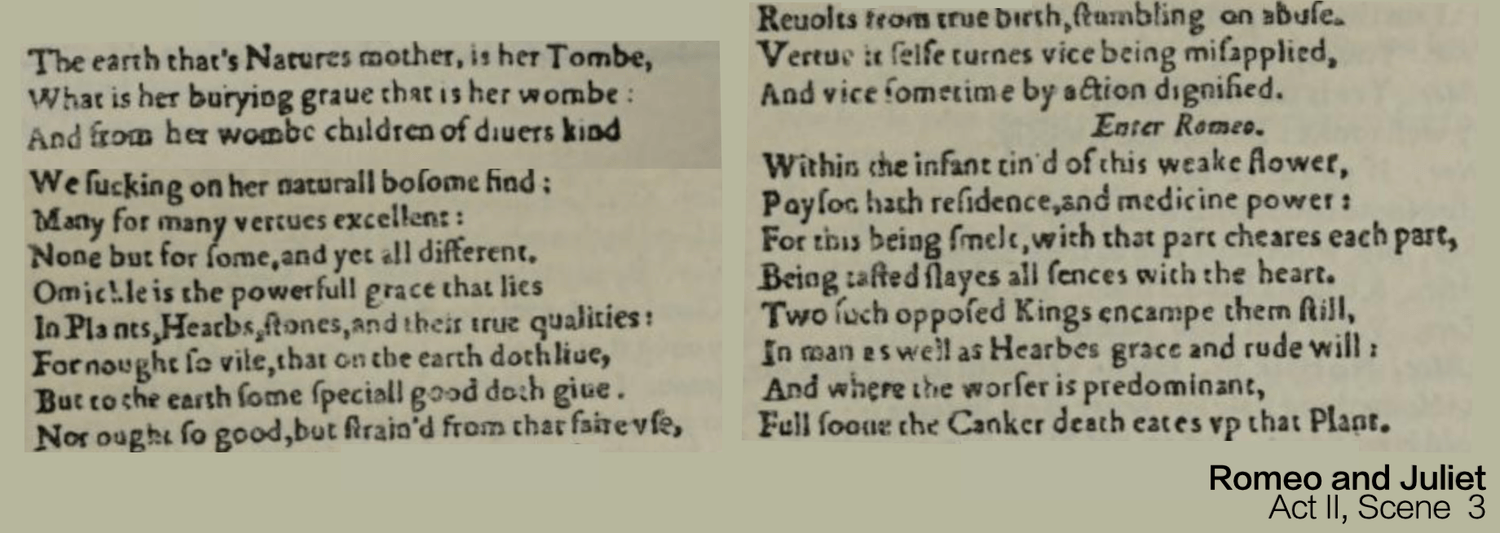
The earth that's nature's mother is her tomb;
What is her burying grave that is her womb,
And from her womb children of divers kind
We sucking on her natural bosom find,
Many for many virtues excellent,
None but for some and yet all different.
O, mickle is the powerful grace that lies
In herbs, plants, stones, and their true qualities:
For nought so vile that on the earth doth live
But to the earth some special good doth give,
Nor aught so good but strain'd from that fair use
Revolts from true birth, stumbling on abuse:
Virtue itself turns vice, being misapplied;
And vice sometimes by action dignified.
Within the infant rind of this weak flower
Poison hath residence and medicine power:
For this, being smelt, with that part cheers each part;
Being tasted, slays all senses with the heart.
Two such opposed kings encamp them still
In man as well as herbs, grace and rude will;
And where the worser is predominant,
Full soon the canker death eats up that plant.
Shakespeare, using Bacon’s pen, was warning that the most powerful weapon wielded by kings is the infant.
It’s the young people who are expected to fight the wars of the old people. This was expressed in Nemesis by the sister of Verity Hunt’s killer, a spinster living out her old age in the Manor House, commenting on the disposable nature of the young: “[D]uring the war one could not get any gardeners. We had a very young gardener and then he was called up. One does not of course grudge that…”
That’s what the young are for.
And so Miss Marple ends her “truth hunt,” in which she attempted to solve the murder of the young by their perpetually warring fathers and mothers. She ends that hunt by acknowledging the power of Roman or romantic love to draw recurring generations of infantry into prolonging wars they didn’t start.


Stephanie McPeak Petersen
Join me on deep dives into Shakespeare, Francis Bacon, harmonics, economics, and hidden history.


My husband Allan's website:
Stay connected with my updates delivered straight to your inbox.