
Billionaires aren't natural
I saw this video recently and, in it, Barry explained that when people become rich, they tend to lose empathy. This was based on some studies cited in the video, but it reminded me, again, how unnatural it is that rich people even exist.
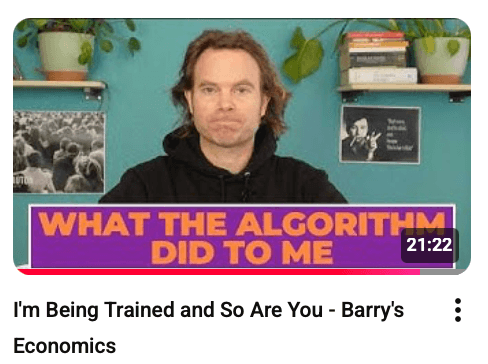
Getting super rich really shouldn't ever happen, and in a truly "natural" economy it doesn't. Where it does tend to happen is in corrupt, slave-based ancient empires, as well as medieval, serf-based feudalism and modern, debt-based corporatism. But basic, natural patchworks of smaller economic systems expressing non-coercive, normal, responsible economic behaviors just don't produce billionaires.
The fact that billionaires exist is proof that an economic system is unnatural: fake, rigged, and fenced off with barbed-wire legal protections.
In his video, Barry thought that a wealth tax was the answer to the problem of rich people (and their lack of empathy), but a wealth tax doesn’t target the root of the problem of unnatural levels of richness. A wealth tax ignores how people get super rich in the first place, and it’s the loopholes creating billionaires that we really need to target.
At the core of my thinking on this is that, while people should be free to pursue any goal that lies within the bounds of the non-aggression principle (ie, freedom to aim for billions is important philosophically), we can probably agree that there’s nobody who's ever earned a billion dollars doing anything. Life saving inventions earn far less, and billions rarely flow toward the most deserving in society. In a natural economy, even if you created a thing of value that a billion people would buy at $2 a pop (politely covering your tax bill), that thing would face competition immediately, and you'd be splitting your billion with several competitors. (Not to mention the fact that natural economies don't comprise a billion people; scaling to that level is highly, grossly unnatural... see Small is Beautiful by Schumacher.) No, to rake in billions requires something else entirely.
Capitalism
This subheading is intended to give the members of Barry's audience, should they ever wander over here, an anticipatory (though brief) excitement that their views are about to be validated. However, no, it's not capitalism that's necessary to pull in billions. In fact, capitalism tends to prevent that.
The reason it prevents making anyone super rich is because of what capitalism actually does do: it forces you to stop overconsuming and start saving. Capitalism is an economic system by which you create wealth using unconsumed resources. And let's face it: billionaires don't get rich by consuming less and saving more.
Capitalism is a system of producing wealth using capital. Don’t miss how important that is: capitalism is based on saving. Capital is unconsumed resources, so you see how this idea of saving is implicit in the system’s name. What this means is that, if you want a loan from me, the only money I can lend to you is money I haven’t already spent on myself.
That is capitalism. And it’s no fun, economically speaking. It’s the “eat your spinach first” type of economics, and it's the type the super rich and powerful hate because it’s boring. Also, it doesn’t make them rich.
Capitalism is defense, not offense. It allows you to keep eating through the winter because you didn't consume your entire harvest in the fall. You deferred consumption, which means you were responsible. Safe, secure, and responsible. And boring.
The robber barons didn’t get rich because they were good savers. What makes people rich, really rich, boils down to the ability to control and limit the economic behaviors of other people, and that control can take many forms.
Monopolies are a form of that control. But so are casting couches. Movie stars get rich because the movie industry creates movie star scarcity. Are great actors really scarce? No. There are millions of great actors, great singers, great dancers, great athletes, and great authors everywhere. But practically none of them can get rich in their field because they’re not invited (they can’t gain access) to a very rigged and controlled game. You're free to be an actor or even make a movie. But distribution of your movie is likely to be blocked by industry gatekeepers who control their industry with an iron fist.
Another way to control the economic behaviors of other people takes place in the casino we call the stock market. Many people get rich there, but not because they’re good savers. Stock prices are largely manipulated. High-frequency algorithms can undercut any buy order and change the market price at any given moment. Buys and sells are influenced (and thus, controlled) by stock picking gurus in the media. Occasionally, luck will result in someone outside the "club" getting super rich in the stock market, but luck is fleeting. For long-term gains in that market, you need the ability to control, manipulate, and influence the economic behavior of other people repeatedly. The gurus will tell you to be patient, hold your positions for decades, and you'll get rich, too. Maybe you'll beat inflation, but never forget that price manipulations, performed daily, can wipe out your 20-year gains in an afternoon.
Capitalism (saving) has nothing to do with any of this. No, to pull in billions requires something else entirely.
Government
Controlling the economic behavior of other people isn’t capitalism at work. Usually, it's government at work, whether federal, state, local, or even just unions, trade guilds, licensing boards, accreditation entities, even “ethics” boards.
Federal regulatory agencies are the most powerful bodies controlling economic behavior. This is the centralization of industry gatekeeping, barring access simply by making it too expensive for small firms to compete with large ones. One way this is done by creating laws that all firms will break: that's a given. Survival then becomes possible only by the firms that can afford the resulting fines. There are many, many other ways to do this; if you know of some, please add them in the comments.
The control exerted by state and local government has everything to do with how and where businesses can set up shop. Unions often join bosses in quashing the growth of smaller competing firms. Trade guilds decide who can enter smaller industry territories and what participating firms can charge, even hours of operation. Licensing and accreditation boards keep the industries expensive with regular fees for simply existing. And ethics board decide who to scrutinize and who will be blessed with a blind eye.
These various forms of governing control are the gatekeepers allowing those at the top to access the powerful rigging levers of economic control.
Capitalism (the system of saving and producing first) has been demonized by these guys for one very important reason: because the rich can’t get or stay rich when the country is saving its money and delaying consumption. But also for a much less obvious reason, that's only revealed when you know what capitalism is: they don't want to be bound to the rules of a capitalist system that offers no clear path to their goal of billions.



Stephanie McPeak Petersen
Join me on deep dives into Shakespeare, Francis Bacon, harmonics, economics, and hidden history.


My husband Allan's website:
Stay connected with my updates delivered straight to your inbox.