
The Winners Write the Dictionary
[This article is also available as a video.]
We know that the winners write the history. But are the winners also defining the words?
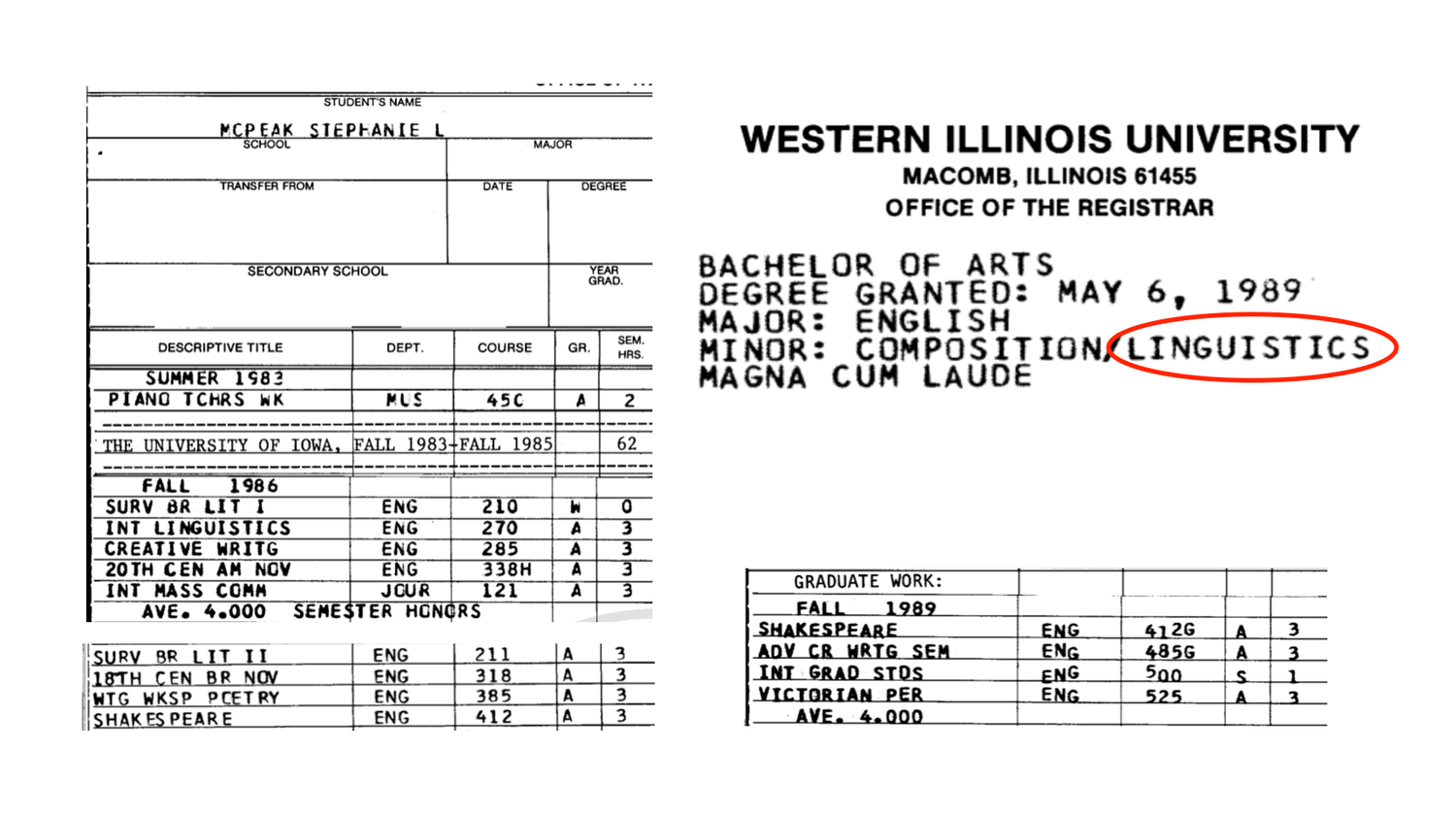
In my research, I love to question etymologies, and with more than just a bias toward conspiratorial explanations. I hold a minor in linguistics. My alma mater probably regrets that move, but I don’t come at etymology bashing from a completely random, uneducated position.
I encounter deceptive definitions and questionable word origins all the time in my research. Some interesting words I have aggressively challenged include:
alchemy — We’re told alchemy derived from the Greek khymeia, meaning “chemistry.” But earlier on it meant to “pull together” or “combine,” another way of describing incorporation. And if khymeia meant incorporate, might AL-khymeia possibly mean the opposite of that? To un-incorporate? Especially since that's what a lot of alchemy is attempting to do?
forgive — The mainstream etymology says that the word forgive is the act of giving “completely,” as for means “completely.” But here in Denmark, where I’ve been living for the last year, forgive translates as eftergive, meaning to give after. This would suggest that the for prefix in our English word means “before,” not “completely,” and could have implications regarding why we use the word forgive with respect to debts.
tellurium — This mineral was supposedly named for the Latin tellur, meaning “earth.” But most mineral names highlight specific features; they don't give the vague location (the ground) where most minerals are found. The Latin tellum, however, means “weapon,” “sword,” and even “blade,” which would be more in keeping with tellurium’s bladed appearance.
cupellation — They say this word derives from the Latin cuppa, meaning the cupel or vessel in which metal assays were performed. Two reasons to doubt this: 1) cupio is more relevant to the act of high-heat separation, meaning “to smoke, boil, or move violently,” and 2) cupio is much older than cuppa (late Latin), meaningful in light of archeological evidence of cupellation relics from the Bronze Age.
coin — The etymology of coin tells us the term derives from cuneus, a wedge-shaped die for stamping. And cuneiform is the ancient writing system from Mesopotamia that wasn’t a language, but more of an alphabet (or even a font?) stamped into clay with a wedge-shaped tool. Money evolving from paper receipts may be a much younger brother to the story of money evolving from clay tablets.
vampire — The mainstream explanation here is that the term derives from ubyr meaning “witch.” The linguist Max Vasmer finds this doubtful and so do I. I’m struck by how similar the root vam- is to the English womb. The term vam means warmth in Volapük, the “world language” the Roman Catholic priest Johann Schleyer invented. Warm is varm in Danish, and vam/varm seems related to the warmth of a womb. It pulls my mind to the concept of “womb fire” which would be in keeping with the definition of "star fire" as menstrual blood, something Egyptian kings drank during the star fire ritual.
That's just a quick smattering, and in Chapter 7 of The Next Octave, a chapter called “Musical Speech Codes,” I look at the weaponizing of the dictionary with respect to economics.

Economist Friedrich von Hayek wrote that a market’s price system contains aggregate knowledge in the form of informational data points. The only way to determine where purchasing ability and willingness of society is on any given product can only be found in “the dispersed bits of incomplete and frequently contradictory knowledge which all the separate individuals possess… Fundamentally, in a system where the knowledge of the relevant facts is dispersed among many people, prices can act to coordinate the separate actions of different people…” This information is shared from person to person and informs the market through the ongoing conversation of supply and demand.
The government imposition of a fixed price, however, is a redefinition of terms in
that conversation. Such a redefinition of terms by government was brashly defended by economist John Maynard Keynes in 1930. Praising the ideas of Georg Knapp in his State Theory of Money, Keynes wrote that the government “claims the right to determine what thing corresponds to the name, and to vary its declaration from time to time—when, that is to say, it claims the right to re-edit the dictionary.” Truly expressed levels of supply and demand are merely impediments to the economic policies governments seek to install. Rather than allowing the market its ongoing conversation forming agreement on prices, temperaments imposed by central planners redefine prices with numbers the government chooses.
Not surprisingly, the first word I set out to return to its original definition was capital. Also from The Next Octave:
In today’s modern lexicon, the term capital has suffered the greatest re-definition of all. In 1848, Karl Marx claimed that, “Capital… [is] a species of property which plunders Wages-labour, for Capital can only increase on condition of creating a new supply of Wages-labour, in order to use it up anew.” Under Marx’s labor theory of value, capital was no longer the harvest one reaped and saved. Instead, capital was redefined to mean co-opted labor, a term that was also redefined to be the only act of value creation. This meant capital was now the excess profit a firm made after paying its employees their wages, as Marx
believed labor created the total value of any commodity. The apple pie had gained no value from unconsumed apples set aside for its creation (the old definition of capital). Now, the entire value of the pie was represented in the time and effort it took to bake it. In this way, the concept of capital as the necessary and sustainable act of deferring consumption was lost to humanity, and debt-based systems were free to proliferate beyond their earlier limitations. We can blame this Marxist redefinition for our current levels of overconsumption today.
One of the most frustrating experiences I have on a pretty much daily basis is seeing people blame capitalism for the effects of our debt-based monetary system, effects like overconsumption, commercialism, and corporate monopolies. Teaching others to question and even challenge definitions and etymologies might be our first task in escaping this frustrating aspect of the matrix.
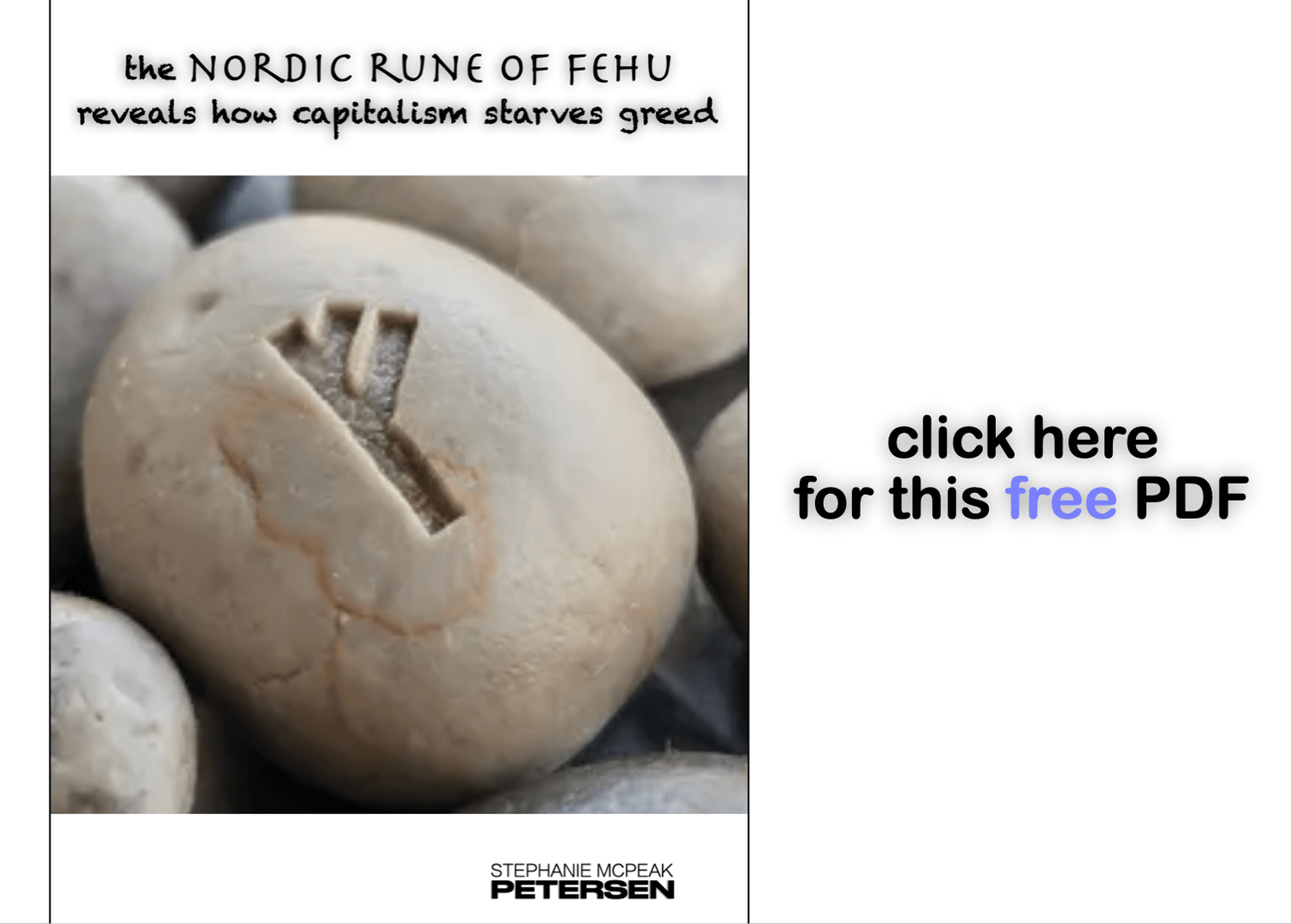
That's what I'm trying to do below, in the free PDF that I offer here on my website. Please feel free to access it, read it, and download it to your own computer, and if you meet someone who is operating under the incorrect definition of capitalism, please share it with them so we can start to fix some of these intentional misdefinitions of words.


Stephanie McPeak Petersen
Join me on deep dives into Shakespeare, Francis Bacon, harmonics, economics, and hidden history.


My husband Allan's website:
Stay connected with my updates delivered straight to your inbox.