
Tartarian Capital vs. the One-Eyed Monopoly
[This article is available as a video.]
The pyramid-backed eye on the US dollar bill is generally accepted as a masonic symbol representing the all-seeing eye of God. And when celebrities pose with one eye covered, we're told they're hinting to us that they're freemasons, just innocent members of a group that's also humbly subject to the all-seeing eye of providence.
That's debatable.
As a symbol, the single eye has a long and varied history, but it interests me as being central to both money and Shakespeare. And when you pull those two threads together, the eye and the money, something that was hidden begins to emerge. It's a truth that the mercantilists of Europe world tried to bury, but that the earlier Tartarians and Moors very clearly understood.
In the Shakespeare play, “King Lear,” the Earl of Gloucester is attacked by Cornwall, who gouges out one of Gloucester's eyes. The king's daughter Regan then states, in a well-known line, that one eye will mock the other. To prevent this strange power of the single eye, Cornwall removes his second eye as well, leaving Gloucester completely blind.
This act of mocking is important and holds a hidden meaning.
Mockery means to “belittle,” but another definition of mockery is, "an imitation of lesser quality." It's from this definition we get the terms “mock up,” meaning a slapdash representation, and “mock trial,” an imitation of a trial.
Understanding these definitions of mockery and mock, we can start to see that the one eye peering out at us from the dollar bill is mocking, or imitating real money. It's a “mock up,” a poor representation of something real.
The word money is already telling us that it’s “one eye,” or “mon-eye.”
The suffix mon- or mono- means "one," from the Greek moneres, meaning alone. The term money is, literally, one eye, referencing the shape and glint of a coin. This is why a man with a monocle metaphorically represents wealth. It's also why a man with an eye-patch represents a pirate, or thief.
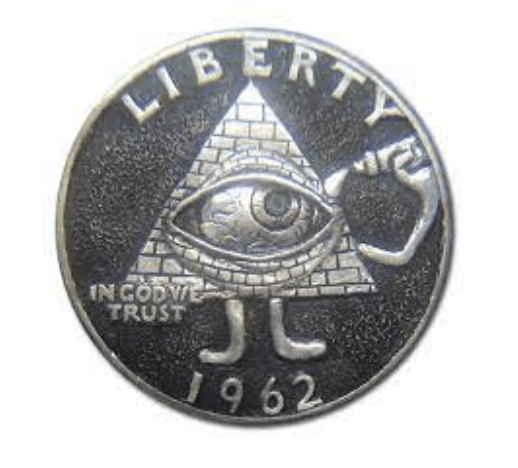
Shakespeare was well aware of the symbolic connection between the single eye and the coin, and he recognized it as a symbol of corruption, as we see when Iago hypocritically describes Othello, the noble Moor, as "an eye" that can stamp and counterfeit advantages. Shakespeare also used the word oneyer (a word that looks like a portmanteau of one and eye) on page 53 of "Henry the Fourth," part 1. (That page number, 53, is a masonic value I break down in detail in The Alchemical Solfeggio.) The word oneyer is only ever found in Shakespeare, so it’s a term he coined, as it were. And according to Shakespeare scholar Edmond Malone, the word oneyer is describing an accountant of the exchequer, a banker.
The coin symbolizes the eye, and the eye mocks the coin.
The latin phrase E pluribus unum has been imprinted on our money off and on since 1795. It means: from many, one. That seems pleasant, a celebration of unity under one banner. But another way of looking at unification is to see it as a conglomeration. The absorption of the many into one large, centralized, all-powerful system. E pluribus unum means MONO-POLY: one from many, many originally competing forces merged into one. In other words, it’s the centralization of power for the corrupt purpose of removing the natural competition that keeps things from growing and expanding too large, like a metastasizing, doubling octave.
The idea of only one when there should be more than one is the basis for the word monster, historically meaning a one-eyed creature: the cyclops, the sea monster. One eye where there should be two. One power where there should be many.

Merchant-ism
So how is money portrayed in the works of Shakespeare? A good place to look is in “The Merchant of Venice,” where a payment of debt is equated to a pound of human flesh. And this is absolutely key to how the playwright views money: Shakespeare is not equating money with wealth, but with a part of the human body that must simply remain intact for continued survival.
Money is nothing more than back-and-forth survival. Wealth, as I show in this free PDF, The Nordic Rune of Fehu, wealth is something else entirely. Wealth is capital. Wealth is what you haven’t consumed. It’s what you’ve saved. It can grow over time if you’re wise and don’t consume it. As Google AI tells us, “Money is capital when used as an investment to generate profit, increase value, or purchase income-producing assets (machinery, raw materials, stocks). Money is not capital when it serves merely as a medium of exchange for personal consumption, is held as cash, or lies dormant without being used to produce more value.” Money can function as capital, but in a debt-based system, when money is created as debt, or it’s systematically debased, capital is not money’s default setting.
Shakespeare’s understanding that wealth and money are two different things is apparent in “The Merchant of Venice,” when Antonio tells Bassanio: "Thou knowest that all my fortunes are at sea, neither have I money.” His fortunes are his investments of capital, his wealth, and that’s distinct from his money. This is a sharp economic insight for Shakespeare in this time of mercantilism.
The central tenet of mercantilism was just the opposite, that money and wealth were the same. As such, gold (considered both money and wealth) was valued more highly than commodities or merchandise on a macro level and mercantilist nations were keen to draw gold money into the country and export merchandise out.
The words “merchant” in the play’s title, and “mercantilism,” which was the economic system of the time, are interesting in their etymology. Both are broken down into mer-, meaning “sea,” and chant or cant, which is a secretive language of thieves, also known as peddlar’s French, that’s evolved into the modern day term “jargon.”
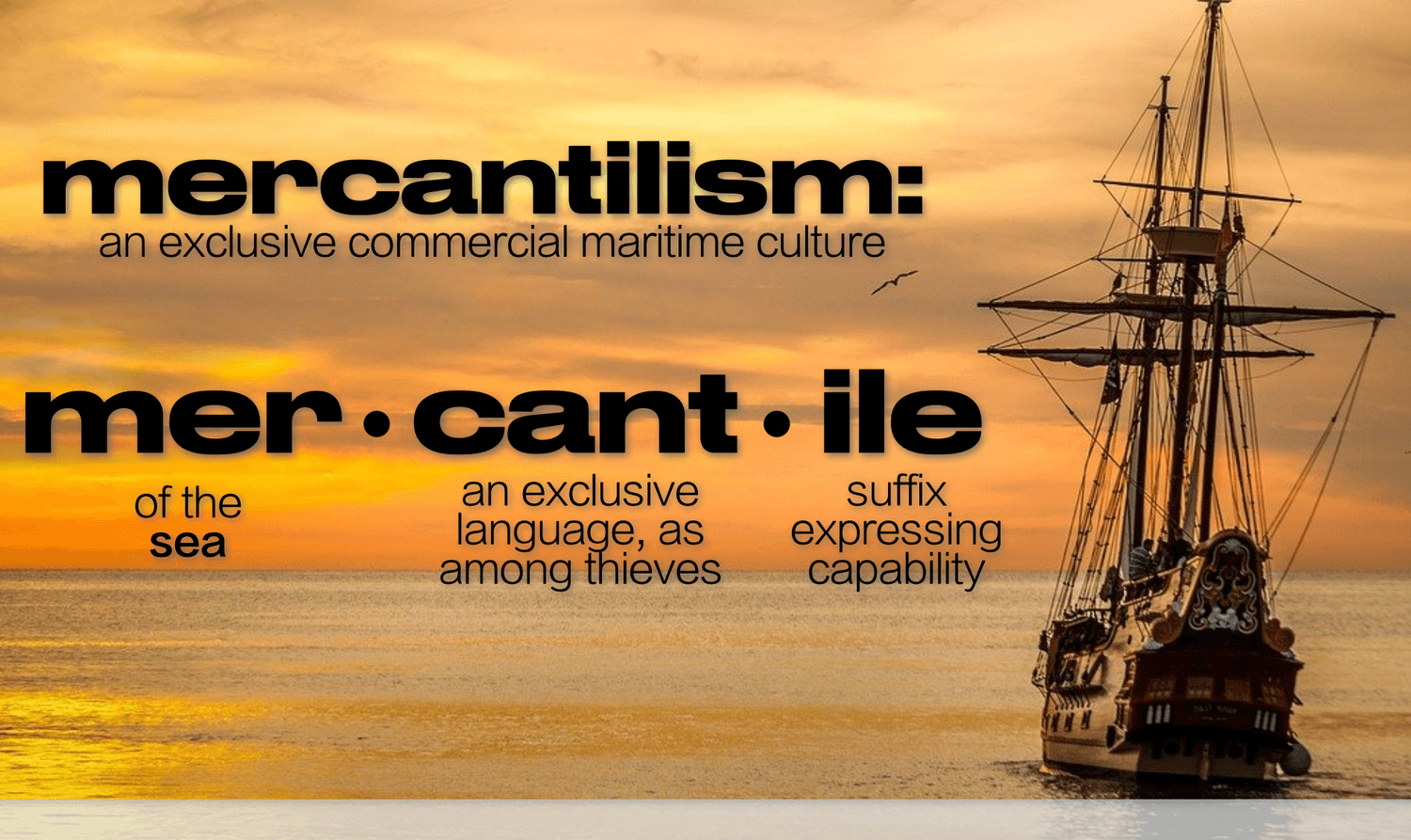
These peddlers and pirates spoke the code of "sea language" (mer-chant) to one another about secretive things they didn’t want the public, at large, to understand. And this is still true today. Economics is largely obfuscated behind ill-defined jargon, complex formulas, and lengthy explanations that the public is not supposed to understand, which is why Shakespeare’s high level of economic knowledge is so unusual.
Literary analysts marvel that Shakespeare was so well versed in the legal and economic nuances of his day, but as a Baconian (someone who believes Bacon authored Shakespeare), I believe that knowledge originated not with an actor like William Shaksper, but with a jurist and statesman like Francis Bacon.
We can see from his own writings that Bacon was often at odds with mercantilism. In the Advancement of Learning he wrote that the sinews of fortune are not money, illustrating the same split between the fortunes of “The Merchant of Venice” and money. But Bacon went even further. In “New Atlantis,” Bacon goes even further in refuting mercantilism because, here, the governor of the Strangers House tells arriving voyagers: "As for any Merchandize you have brought, ye shall be well used, and have your Return, either in Merchandize, or in Gold and Silver; for to us it is all one." He’s not saying that money and wealth are one, because merchandise is not wealth. He’s saying that the New Atlanteans did not value gold above merchandise. Their value as the same, a view in sharp contrast to mercantilism, and it was also a view that was well before its time.
Bacon calls the governing authority of New Atlantis "Salomon's House," described as the very eye of the kingdom. The single eye again. Notice that this governing house had been saving money, not debasing it. This sounds like an island economy based on a saved resource, capital, and though Bacon wouldn’t use that word, an early form of capitalism does seem to be what he’s describing. Capitalism, a system based on unconsumed resources, has nothing to do with the government protections of mercantilism, or merchant-ism: protectionist trade policies for the benefit of the domestic merchant (at the expense of both the domestic consumer and the foreign merchant).
Mercantile Gambling
The parallel storyline in “The Merchant of Venice” involves a series of men competing to marry a woman named Portia. To win her hand in “romance” (to incorporate with her like a Greco-Roman city state), each suitor is given the opportunity to choose the correct casket out of three options: gold, silver, or lead.
On the gold casket is written: "Who chooseth me shall gain what men desire.” On the silver casket is written: "Who chooseth me shall get as much as he deserves.” On the lead casket is written: "Who chooseth me must give and hazard all he hath.”
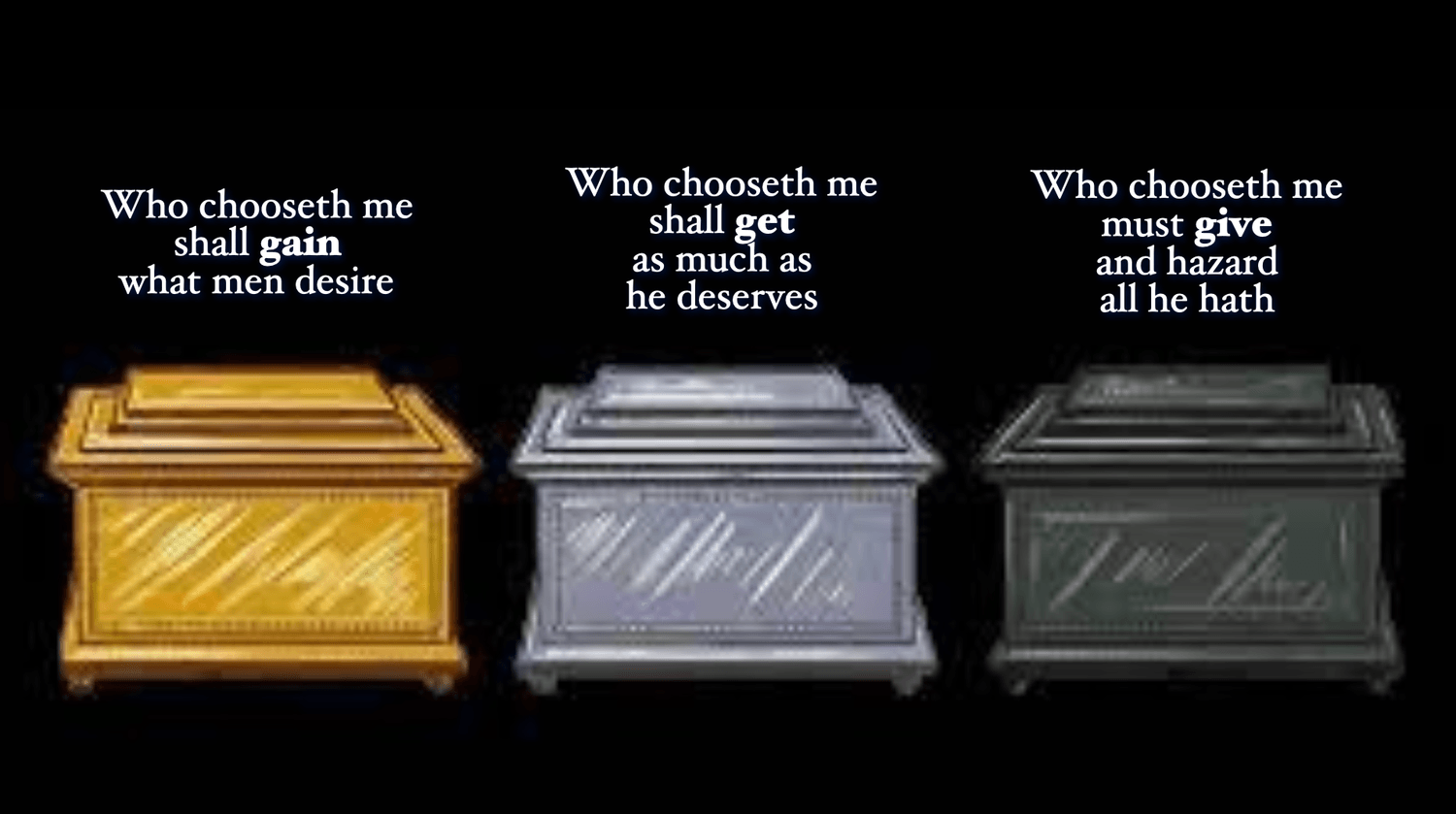
The suitor portrayed as most sincere is the Moor, the Prince of Morocco. He is the fifth suitor, after four strangers. And in my research into “New Atlantis” and its cipher regarding musical intervals, the 5th is significant, as I discuss in Chapter 14 of my book, The Next Octave. The Moor, as the perfect 5th, is being displaced by the tritone. Temperament is responsible for this displacement, and musical temperament is something I explain in the book as being a “debt” to the note. So the Moor, the 5th, is displaced by the debtor, Bassanio.
As he considers the riddle of the lead casket (spoiler alert: the lead casket wins Portia), the Moor says something important: "They that hazard all do it in hope of faire advantages." Not only does the Moor see through the lead casket as an attempt to gain advantage in what should be a mutually beneficial transaction, but he recognizes the hazard of the lead casket to be nothing more than a bet. And the Moor is not given to gambling.
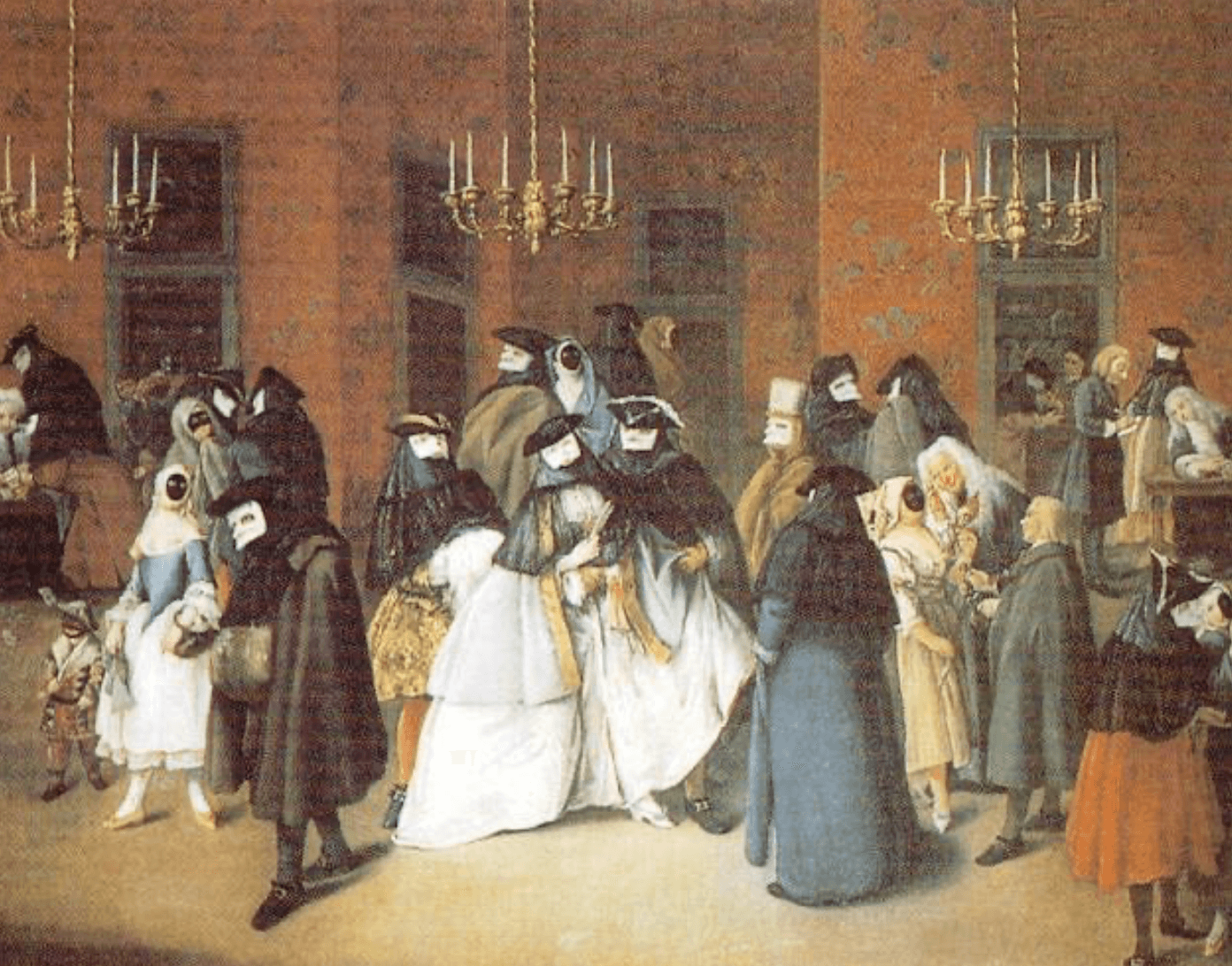
Bassanio, as a Venetian, is given to this vice, because Venice, during Carnival, had a thriving market for something called “mercantile gambling” or “bank gambling.” Unlike social gambling, mercantile gambling was a commercial venture in which the house always held a statistical advantage in games of chance. The Republic of Venice was the site of the world’s first official casino, the Ridotto, opened by the Venetian Great Council in 1638 (several decades after “The Merchant of Venice” was written) to control and tax this profitable industry, shown here in the painting “Il Ridotto” by Petro Longhi.
Venice was built on water, the jurisdiction of commerce, with the root of mer-, that you’ll recall, refers to the sea. For those of you who may question this claim, it's substantiated in Black’s Law Dictionary of 1891. Here, the word commerce wasn’t considered a “scientific” term, but the dictionary did explain commercial law and mercantile pursuits this way: “As foreign commerce is carried on by means of shipping, the term has come to be used occasionally as synonymous with ‘maritime law’…” The fact that the truth regarding these jurisdictions isn't well documented, however, is explained by the fact that the language of law is also meant to obfuscate, sometimes dubbed "legalese," and in fact, much common law was codified in the Renaissance using either Latin or Law French (similar to peddlars' French?) to keep legal understandings out of reach of the masses.
While the sovereign individual functioned within the jurisdiction of the land, the corporate “person” functioned within the jurisdiction of the sea, on which the ships of merchant adventurers sailed, or on which mercantile casinos were built in Venetian canals. A corporate person is linguistically very similar to a persona, deriving from the Latin persona that originally referred to a theatrical mask. And in Venice, during the Carnival, the casino was attended by literal "persons" in masks, as we saw in Longhi’s painting, happily engaged in mercantile gambling in the jurisdiction of the sea.
With the corporate person in mind, this line from Antonio in “The Merchant of Venice” takes on more meaning: “Within the eye of honour, be assured, My purse, my person, my extremest means, Lie all unlock'd to your occasions.” Here, Antonio lumps together his person and his purse, as if both are something that a human being might carry around. He’s telling Bassanio that his purse and his corporate person, his economic reputation (his credit score, if you will) are something Bassanio can use to take out a loan, an eye (coin) of honour (one you’re trusted, on your honor, to pay back).
In “Othello, Moore of Venice” another noble Moor is portrayed in the Venetian context of mercantile gambling. This time, though, the Moor is deceived into hazarding his wealth: “…’tis great pity that the noble Moor should hazard such a place…” In this line, the villain Iago is withholding information from Othello, and the hazard mentioned here will later directly hazard Othello’s wealth.
In the play, Desdemona represents wealth, metaphorically described as a “land carrack” that her husband Othello boards. A carrack (carract) was a merchant ship carrying luxury goods, and though ship wealth could be lost at sea (as in “The Merchant of Venice”), the carrack of Desdemona is parked on land.
Again, this is all about the jurisdictions of land and sea. To deceive Othello into hazarding his land-based (sovereign) carrack, Iago employs a corporate person, Rodorigo, to operate in the jurisdiction of the sea, mercantilism. Rodorigo then sells his land to raise cash for Iago, a reliance on the Venetian jurisdiction of the sea. “Thus,” says Iago of Rodorigo, “do I ever make my fool my purse.”
Finally, in the tension we discussed earlier between wealth and money, Iago’s mercantilist preference becomes a monotonous refrain, Put money in thy purse. “Therefore put money in thy purse. If thou wilt needs damn thyself, do it a more delicate way than drowning. Make all the money thou canst.” That choosing money over wealth is the best way to damn yourself is Shakespeare’s (or Bacon’s) point. Iago doesn’t say, “if you want to damn yourself, displace the Moor… or, steal his wife…” He says, “make all the money thou canst.”
Both plays, “Othello: the Moore of Venice” and “The Merchant of Venice,” depict abuse of noble Moors in a city of gambling, hazard, and debt. In Shakespeare’s Venice, advantage (an unequal playing field) is ultimately created through the ability to risk or hazard what isn’t yours, the result of masks, legal fictions, and the purses of persons.
Both plays also use musical metaphors to punctuate the downfall of the noble Moors in a city of gambling, hazard, and debt. In Othello’s 2nd Act, Iago foreshadows his plans to tamper with Othello’s relationship with Desdemona by saying, “"O, you are well tuned now! / But I’ll set down the pegs that make this music.” In the 3rd Act, the Clown speaks on behalf of the Moor, Othello: “But, masters, here's money for you: and the general so likes your music, that he desires you, for love's sake, to make no more noise with it.” Othello is already hearing the mistunings of Iago manifesting in Venice, and uses money, the one eye, to stop the noise, to pay the debt to the note.
In “The Merchant of Venice,” the word meanes, used when Bassanio laments not having the financial means to hold a rival place, refers back to the musical mean, the mese of the scale, the perfect 5th portrayed by the noble or harmonic Moor. The money borrowed from Shylock allows Bassanio to both physically and musically displace the Moor and win Portia's hand, but it’s a displacement built on fiat, built on a mock-up, a loan of real wealth that didn’t belong to him, especially since the credit score making it possible was Antonio’s.
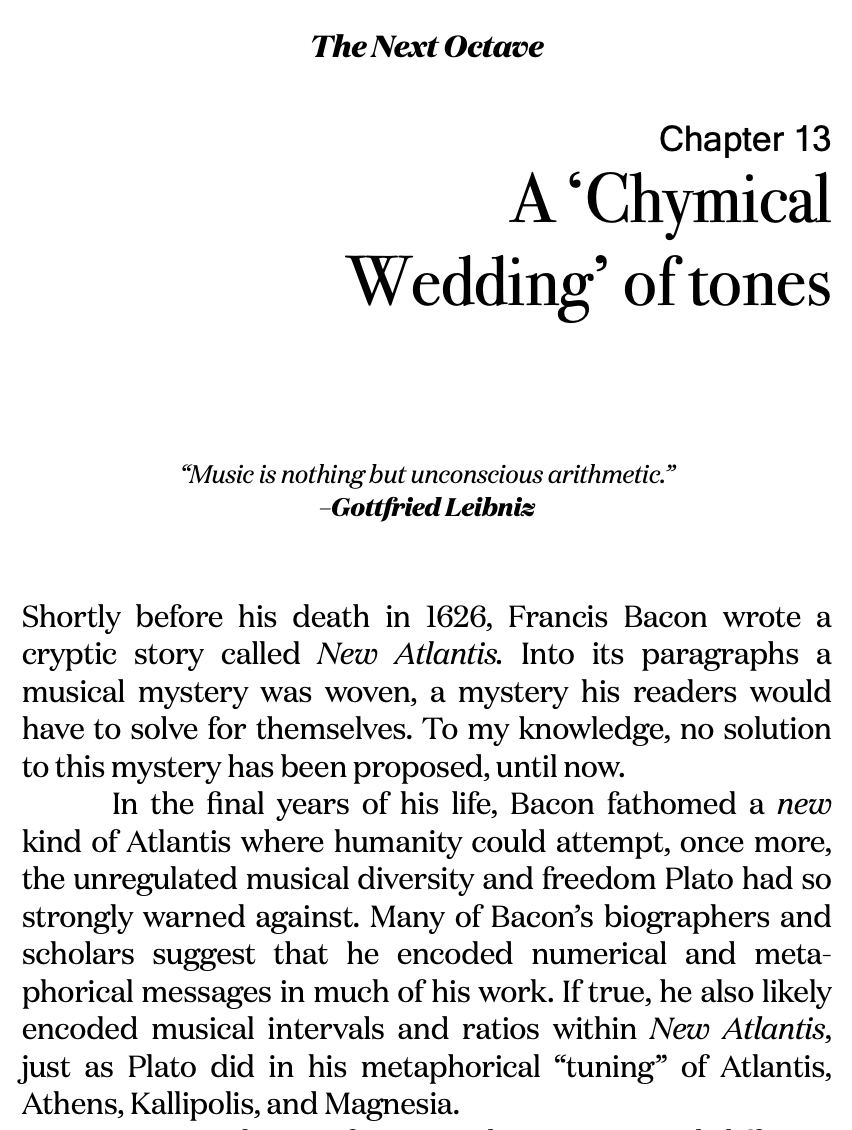
Why is Shakespeare using musical metaphors to illustrate economic truths? Because that’s what Bacon does in “New Atlantis”: "We have harmonies which you have not... We have all means to convey Sounds in Trunks and Pipes in strange lines and distances." The musical grid over which Bacon laid down New Atlantis was the discovery I made that led to the book The Next Octave. and you can read more about the island's musical metaphors in my book's 13th chapter, "A ‘Chymical Wedding’ of tones."
Corporate Pol:icie
A hundred and fifty years after Shakespeare, another critic of mercantilism said this about the economic system of Tartaria: "Among the Tartars... cattle are the instruments of commerce and the measures of value. Wealth, therefore, according to them, consisted in cattle, as, according to the Spaniards, it consisted in gold and silver. Of the two, the Tartar notion, perhaps, was the nearest to the truth.”
This was written by Adam Smith in his 1776 Wealth of Nations in a chapter called “Of the Principle of the Commercial or Mercantile System.” He was making a distinction between Spaniards and Tartars because their behavior made the further distinction between money and wealth, and Adam Smith came down on the side of the Tartarians, a civilization many dismiss today as a conspiracy theory.
But Tartarians were real and their wealth was real. That’s because they based their economy on capital. As I show in this free PDF (which is a fun read, especially if you’re interested in Old Norse or the ancient runes), the word capital evolved from kaput, meaning head, and referred to how many head of cattle, unconsumed, that a farmer or a nation had. Cows with heads were capable of producing value into the future. Cows were real wealth, not paper mock-ups. And this wasn’t just true in Tartaria. This understanding of wealth as unconsumed resources, and the tension between wealth and money, goes back to ancient Rome.
In the middle ages, merchants (for whom mercantilism is named) started to organize in corporate guilds. They were granted charters from the king that gave a merchant guild powers and protections: most notably, state monopolies and commercial jurisdiction while traveling. The economic system of mercantilism hardened around those early corporate charters.
The Muscovy Company was one of these: the Company of Merchant Adventurers to New Lands that was granted a corporate charter in 1555 that gave them a monopoly on trade between England and Russia.
John Frampton, a merchant himself, was sent as a scout to investigate trade routes for the Muscovy Company. His report, published in 1580, stated that the Tartars didn’t have laws or policy, the corporate version of laws. Frampton wrote this word as “pol:icie,” meaning the city, here, which I believe meant that corporate policy was, first and foremost, a change in legal jurisdiction to protect the trade done by corporations of merchant adventurers. The policy of “pol:icie” allowed them to take their own jurisdiction and laws with them into foreign lands.
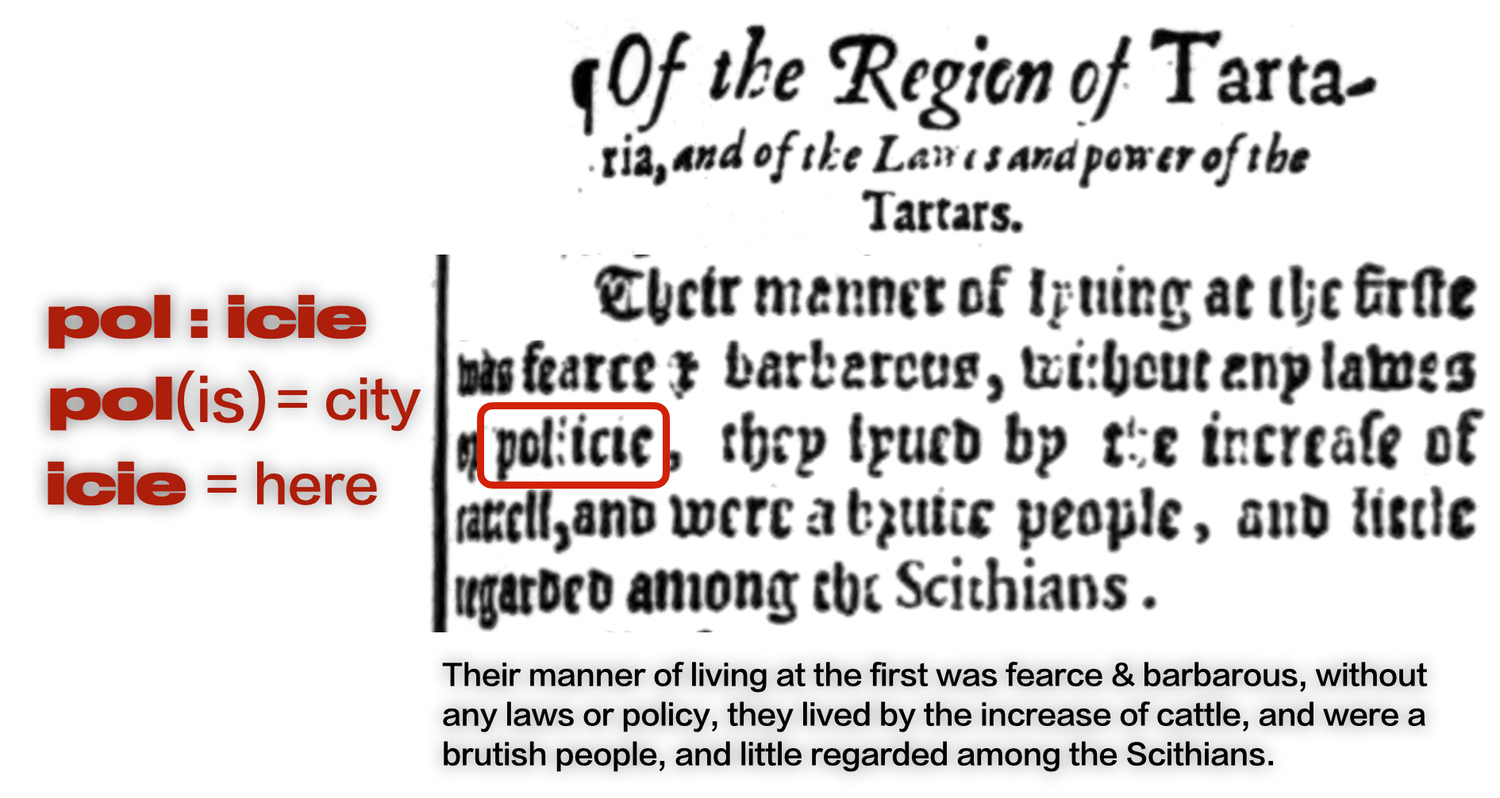
Having no “pol:icie” meant that the Tartarians were not using distorted jurisdictions or corporate protections. This was understood by merchants like Frampton and the Muscovy Company that Tartarians weren’t attempting trade to gain advantage, the kind of advantage the Moor rejects in "The Merchant of Venice." Instead, trade was meant to be mutually beneficial, the way fair trade usually is between two economic participants on an equal playing field, where neither has an advantage over the other. Nothing rigged, no casino with statistical advantages for the house.
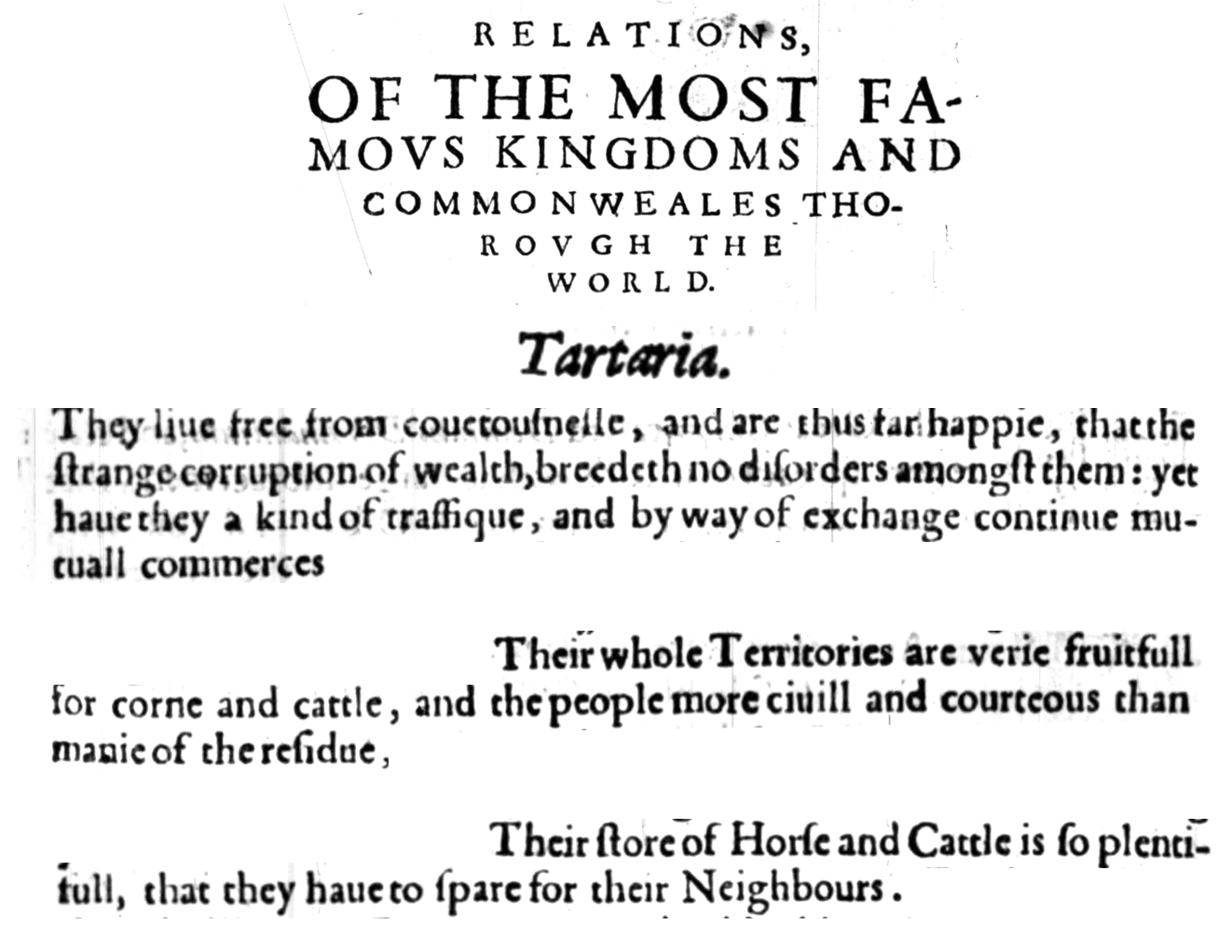
This idea that Tartarian trade was fair is backed up by the reports of Giovanni Botero, who described daily life in Tartaria in his 1616 book, Relations of the Most Famous Kingdoms. Although Botero saw the Tartars as barbaric, he nevertheless reported very civil economic behavior:
On page 322: “They live free from covetousness, and are thus far happy, that the strange corruption of wealth, breedeth no disorders amongst them: yet have they a kind of traffic, and by way of exchange continue mutual commerces.”
On page 323: “Their whole territories (in Caffa) are very fruitful for corn or cattle, and the people more civil and courteous than many of the residue.”
And on page 324: “Their store of Horse and Cattle is so plentifull, that they have to spare for their Neighbours.”
This refusal by the Tartarians to engage in corporate policy protections may be why the Tartarians were so hated and reviled. Their economics threatened the mercantilism, the partnership of state and corporate merchants, that was corrupting most of Europe.
The Moors, who are often associated with the Tartarians in historical and esoteric traditions, carried this same understanding. The Moor in “The Merchant of Venice” refuses to either gamble (hazard) or seek economic advantage. Notice Shakespeare’s detail that the pursuit of advantage must therefore reject gold and silver, and choose the baser metal of lead, a symbol of monetary debasement, the mockery of real money. Shakespeare gives this detail because he (being Francis Bacon, Lord Chancellor and economic advisor to King James I) understood international economics better than anyone in England.
Like the Moors in Shakespeare’s plays, the Tartars are hated and mistreated by characters portrayed as villains. But in two of the plays, “A Midsummer Night’s Dream” and “Romeo and Juliet,” Shakespeare refers to the Tartar’s bow. It’s a symbol of the ferocity of Tartarian warriors, but the bow, itself, is also a symbol of economic capital.
Not surprisingly, arrows represent pain, such as the arrows of outrageous fortune in “Hamlet,” and in “The Merchant of Venice,” arrows specifically represent debt. Bassanio compares a second loan from Antonio to a second arrow shot after the first: “I owe you much, and, like a wilful youth, That which I owe is lost. But if you please To shoot another arrow that self way Which you did shoot the first, I do not doubt, As I will watch the aim, or to find both, Or bring your latter hazard back again, And thankfully rest debtor for the first.”
A loan to Bassanio must be made from money Antonio has previously saved, held back, from money he’s chosen not to spend. The bow, then, represents Antonio’s unconsumed capital. And this is where money CAN convert into wealth: unspent money that’s loaned out now has the ability to multiply into more value in the future through the charging of interest.
The Tartarians, whose economy was based on capital, are the craftsmen of bows in these fictional worlds penned by Shakespeare, and he portrayed the Tartars, along with the Moors, as the unpopular economic agents using fair trade instead of corporate advantage and capital rather than debt.
For more on the overlap of music theory and monetary theory, including the full decode of "New Atlantis" and the usurpation of the perfect fifth, see The Next Octave, available digitally on my website at a discount.


Stephanie McPeak Petersen
Join me on deep dives into Shakespeare, Francis Bacon, harmonics, economics, and hidden history.


My husband Allan's website:
Stay connected with my updates delivered straight to your inbox.